

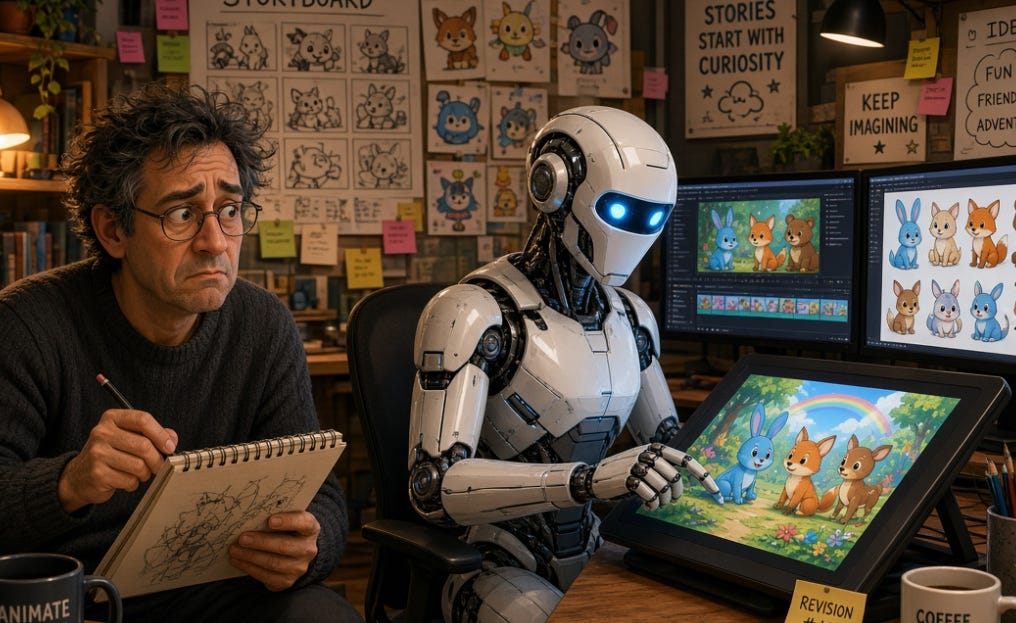
A union-commissioned report predicted 118,500 entertainment jobs would vanish to AI by 2026. The jobs went. Otis College researchers found the roles most exposed to AI actually grew.
The Animation Guild commissioned a study predicting that 21.4 percent of American film, television and animation jobs, roughly 118,500 positions, would be consolidated, replaced or eliminated by artificial intelligence by 2026.
That year is now. The jobs did disappear.
Researchers say AI is not what took them.
What the Otis College research found
Researchers at Otis College, whose work was reported by The Hollywood Reporter, found that the roles considered most exposed to AI, including writers, software developers and artists, grew in number.
The causes they identified were cost-driven displacement of lower-paying roles and structural change in how the business operates.
Jobs disappeared. The pattern does not fit AI displacement.
What actually caused the animation job losses
Three forces show up repeatedly, and none of them is a language model.
Kids commissions fell 18 percent. The category that employed a large share of television animation contracted.
Production moved. Steve Kaplan, business representative at the Animation Guild, described the pattern directly: “What we are seeing is a desire to take more of the work away from California, where it’s not incentivised, and move it to states or regions, both in the US and outside, that provide government subsidies for the work.”
“Moana 2” was reportedly the first Disney feature to split animation between Los Angeles and the company’s Vancouver facility.
The streaming boom ended. Studios that spent aggressively for years began optimizing budgets rather than growing headcount.
The layoffs were real
None of this means the industry has been stable.
Named studio animation cuts since 2023 total well over 1,000 roles, spanning Netflix Animation, DreamWorks Animation, Pixar and Aardman.
Disney announced roughly 1,000 layoffs on April 15, with Marvel Studios’ Visual Development department hit hardest. Forbes attributed the cuts to a reduced Marvel slate and cost-cutting.
Visual development artists are the people who design what a Marvel film looks like before anything is built.
What the Animation Guild contract actually won
The 2024 negotiation produced a deal members are still arguing about.
The guild ratified its 2024 to 2027 contract with 76.1 percent in favor, after reaching a tentative agreement on Nov. 23 following three months of bargaining.
It secured protections preventing AI-generated work from undermining member pay or credit, plus studio notification obligations.
Members did not win the right to opt out of using AI. They did not win the right to keep their work from being used to train AI models. They did not win minimum staffing levels.
They did win a minimum of three writers on animated television shows, with exceptions, and pay equity provisions for color designers, a traditionally female-dominated craft.
The disagreement inside the union
Two people on opposite sides of the same deal, both quoted at ratification.
Shion Takeuchi, creator of Netflix’s “Inside Job,” argued the agreement contained “no substantive protections” against AI. “In this MOA there is nothing to stop the studios from gutting the staff,” she said. “We are chattel to them.”
Teri Hendrich Cusumano, a union vice president who served on the negotiating committee, described the limits differently. “We did the best we could. It was definitely a long, drawn-out process. From my point of view, it felt like we bled them dry at the table. There really wasn’t much left to gain.”
Animation writers make less than half of WGA scale
One figure explains a great deal about the industry’s labor position.
Animation writers work to a minimum of $2,126 a week. Writers covered by the Writers Guild agreement work to $4,515.
Animation scale is less than half, per TheWrap.
The demand for animation has never been higher
Animated titles took the top two worldwide box office slots in 2025, and the most-streamed title in America two years running was animated.
The generative-AI animation market is growing fast, from $2.37 billion in 2025 to a projected $3.23 billion in 2026, with AI handling in-betweening, rotoscoping and clean-up work that once filled a large share of production schedules.
Jeffrey Katzenberg, the former Disney studio head and DreamWorks co-founder, has said a major animated feature once “took 500 artists five years to make,” adding that he does not think it will take 10 percent of that within a few years.
Jeanette Moreno King, the guild’s president, was asked about her 17-year-old daughter wanting to work in animation. “I can’t promise her that that’s going to be possible.”
Article compiled with the help of the Pirates & Princesses newsroom.
Pirates and Princesses is your destination for Disney news, theme park updates, and the pop culture you love. From Disney cruises and travel tips to Disney fashion, food, collectibles, and movie news, PNP covers it all. Visit us at piratesandprincesses.net for daily coverage. Follow PNP on Facebook and Instagram, and listen to the Pirates & Princesses podcast on Apple Podcasts and YouTube.
Hat Tips:
Vidico (August 2026), the compiled industry statistics including the Otis College findings, the ratification percentage, the pay scale comparison and the studio layoff totals
Otis College researchers, via The Hollywood Reporter, the finding that AI-exposed roles grew
Variety, the full contract terms, the Takeuchi and Cusumano quotes and the AI opt-out limitations
Screen Daily, Steve Kaplan’s comments on production incentives, the Katzenberg remarks and the Moana 2 split
The Hollywood Reporter (August 2024), Jeanette Moreno King’s comments
Forbes, via Elite Animation Academy, the April 2026 Disney layoff figures and the generative-AI market sizing