

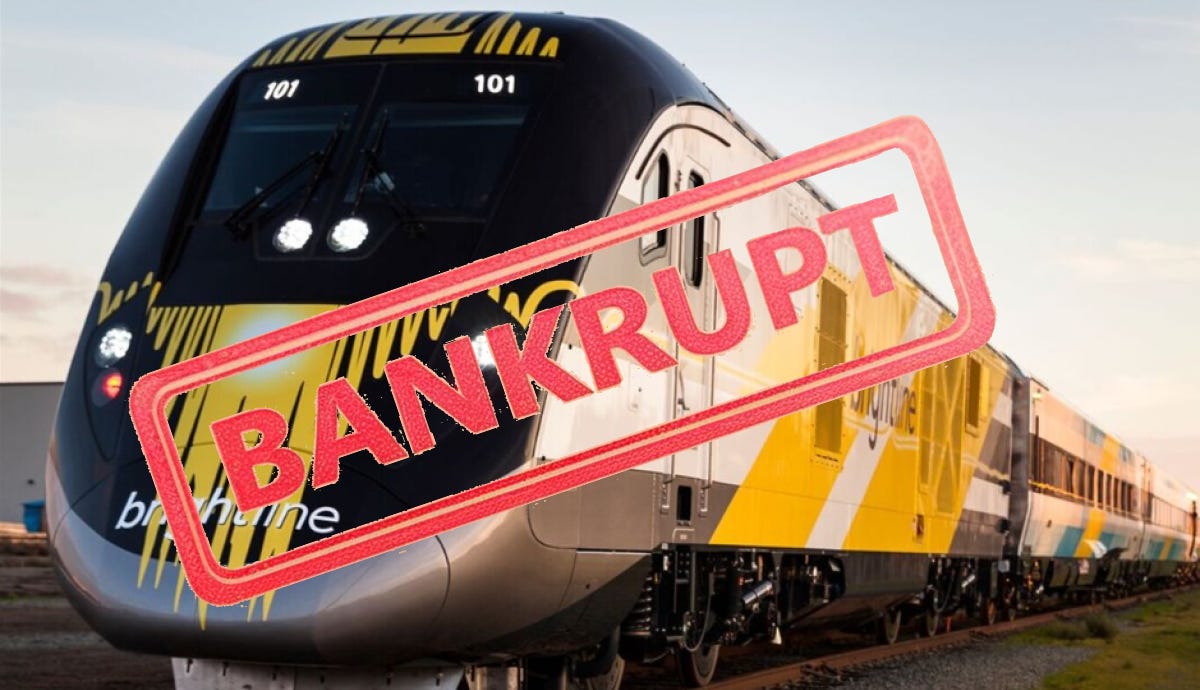
A few years ago, Brightline was sold to Central Florida as a game-changer. A sleek, modern, higher-speed train connecting Orlando straight to South Florida, no white-knuckle crawl down I-4, the first privately built intercity passenger railroad in America in over a century. For theme-park tourists, it really did sound like the future.
The trains are still running. The future, financially, is the problem.
Brightline Florida is now staring down a roughly $6 billion debt load it can’t currently afford to service, and a debt restructuring or outright bankruptcy is widely expected within months. Here’s what went wrong, and what it means for that train you may have been planning to ride.
The trains are popular. That was never the issue.
This is the part that makes the story genuinely sad rather than satisfying. People like Brightline.
Ridership hit a record in early 2026, topping 900,000 riders in the first quarter, up about 20% year over year in March. The Orlando-to-Miami corridor is a near-perfect distance for rail, too far to drive comfortably, too short to bother flying. The premium lounges, the car-free convenience, the escape from Florida traffic: by the experience, it’s working.
So this isn’t a case of a product nobody wanted. The trains are filling up. The problem sits entirely on the balance sheet.
The math never worked
Here’s the brutal core of it. Brightline was built on ridership projections it has never come close to hitting.
The original Fortress Investment Group prospectus reportedly hyped numbers in the range of 5.5 to 7 million annual passengers. Brightline doubled its ridership in 2024 and still landed around 2.7 million, roughly half of what was promised. Fares have been running well below forecast on top of that. Strong growth, real momentum, and still not nearly enough to cover the bills.
And the bills are enormous. The project carries about $5.5 billion in various bonds, and faces more than $2.5 billion in scheduled interest payments over the next two decades. As one Urban Institute researcher put it, the debt taken on to build the thing was simply too high for any realistic assessment of how many riders it would draw.
When you borrow against 6 million passengers and 3 million show up, the gap doesn’t close with a few good months. It compounds.
How bad it’s gotten
The warning signs have been stacking up fast through 2026, and they’re the serious kind.
Brightline’s own auditors at Ernst & Young raised “substantial doubt” about the company’s ability to continue as a going concern, warning it lacks the cash to cover pending debt payments over the next 12 months.
Credit agencies have hammered the bonds deep into junk territory, with S&P cutting the senior debt to CCC- in March and forecasting a likely restructuring. CreditSights estimated that holders of the senior bonds might recover as little as 44 cents on the dollar in a bankruptcy, while lower-ranked debt holders could be wiped out entirely.
The company deferred interest payments and secured a grace period from bondholders, with a key deadline arriving in mid-June. It has hired heavyweight restructuring advisers and is hunting for third-party investors to inject fresh capital. Those are not the moves of a company with options to spare. Those are the moves of one trying to avoid Chapter 11.
Brightline, for its part, is emphasizing the good news. A spokesperson pointed to record first-quarter ridership and revenue and said the company is engaged with partners on options to strengthen its balance sheet and position itself for long-term success.
What it means if you were planning to ride
For now, the practical answer is reassuring: the trains are still running, and a restructuring is mostly a fight among investors over who eats the losses, not a stop-service event.
Even in a bankruptcy, passenger operations would likely keep going while the debt gets reorganized, the way airlines routinely keep flying through Chapter 11. The most likely outcomes if things go badly are behind-the-scenes ownership changes, or down the road, the risk of higher fares or trimmed schedules if a leaner Brightline has to make the economics work. The doomsday version, trains simply stopping, is not the expected path.
So if you’ve got a Brightline trip in mind for your next Orlando visit, you can probably still take it. Just know the company carrying you is in a financial fight for its life.
The bigger lesson for Orlando
There’s a reason this stings for Central Florida specifically.
Brightline was held up as proof that big, ambitious infrastructure could still get built in America, privately, quickly, for the benefit of the tourists and locals who actually move between Florida’s two biggest destinations. And the ironic, frustrating part is that the idea was validated. The demand is real. The trains are popular. People want car-free travel between South Florida and the theme-park capital of the world.
What failed wasn’t the concept. It was the finances stacked on top of it, a debt pile sized for a fantasy ridership number that reality never delivered. Critics have also long argued the “private” railroad leaned heavily on tax-exempt bonds that shifted real costs onto the public, a charge that adds a sourer note to the whole saga.
Brightline’s troubles now hang over its even bigger ambition, a $21.5 billion high-speed line between Southern California and Las Vegas. If the Florida flagship ends up in bankruptcy court, it casts a long shadow over the promise that private money can build America’s trains.
The train that was going to change Orlando still might. It just has to survive its own balance sheet first.
Article compiled and edited by Derek Gibbs (theme park editor) and the Pirates and Princesses newsroom.
Pirates and Princesses is your destination for news, views, and rants on geek lifestyle, fandom, and pop culture. Visit us at piratesandprincesses.net for daily coverage of the things you love.
Hat Tips:
Puck (April 2026), verified for the Wes Edens/Fortress origin, the Florida East Coast Railway corridor acquisition, the 235-mile route, and the debt-restructuring framing
Bond Buyer (May 2026), verified for the Ernst & Young going-concern warning, the $5.5 billion bond structure, the bondholder grace-period extension, and the liquidity shortfall
Bloomberg and Bloomberg Law (March-May 2026), verified for the S&P CCC- downgrade, the CreditSights 44-cents recovery estimate, and the senior/subordinate debt breakdown
Insurance Journal (May 2026), verified for the auditor’s substantial-doubt language, the Urban Institute analyst quote, the Brightline spokesperson statement, and the Brightline West connection
American-Rails (May 2026), verified for the capital-structure detail, the interest-payment schedule, the June grace-period deadline, and the ratings-agency timeline
Main St. Magic (May 2026), verified for the Q1 2026 record ridership of 900,000-plus, the Perella Weinberg restructuring engagement, and the MCO-station tourist-travel context