

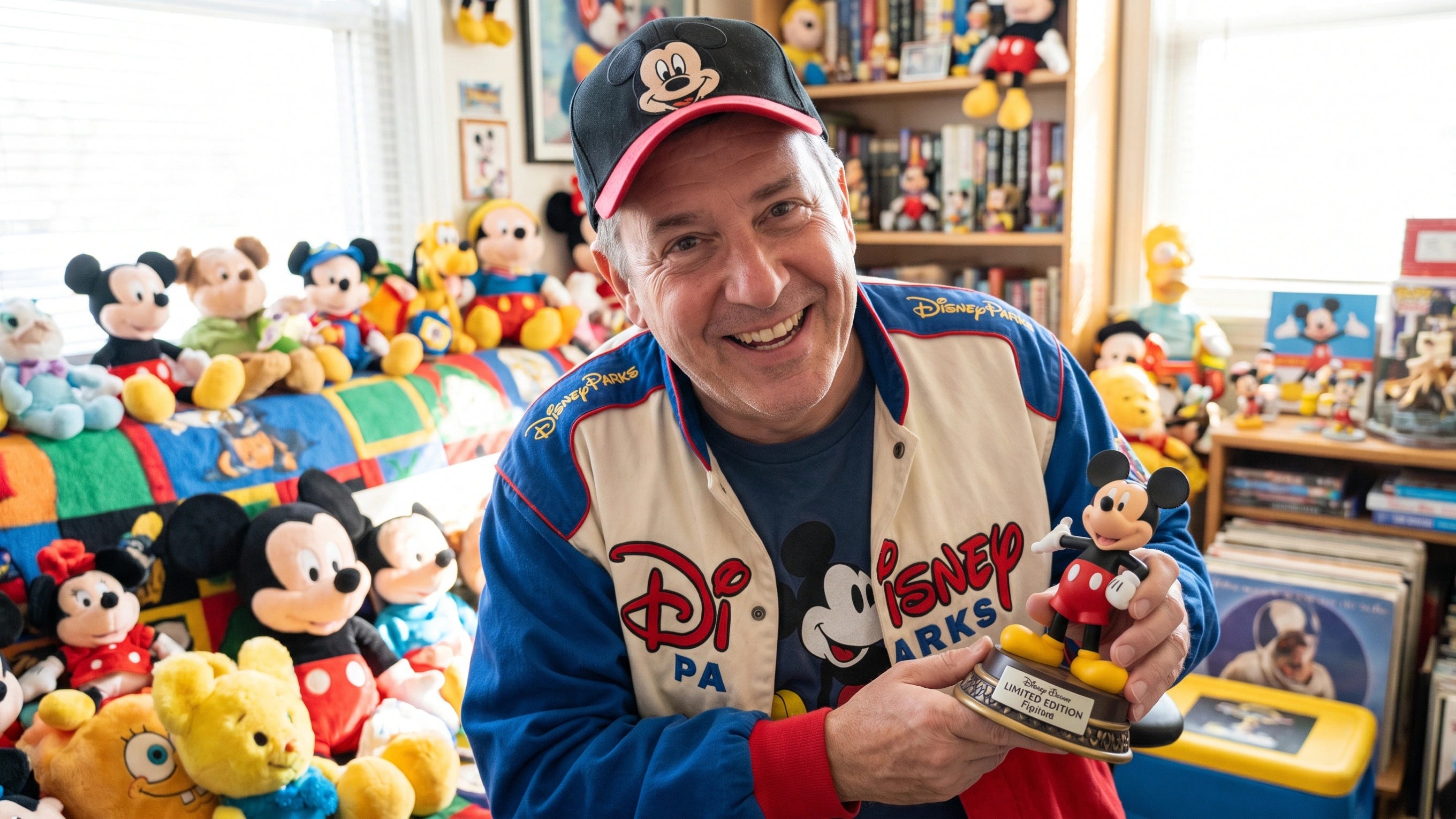
Adults without kids are the biggest group in Disney’s parks, “kidults” drove roughly $9 billion in toy sales last year, and the Disney Channel that once minted lifelong fans has lost 90% of its audience. Here’s the shift happening under the mouse ears.
Here’s a number that stops people cold: at Walt Disney World, most guests don’t have a kid with them.
One analysis of park location data found only about 37% of Disney World visitors came from a household with children under 18. Other estimates land in the same neighborhood — adults without kids are now the single largest slice of the parks crowd, not families.
The place built for children is mostly full of grown-ups. And Disney knows it.
What a “Disney Adult” and a “kidult” actually are
Two terms are doing a lot of work here, so let’s define them.
A Disney Adult is exactly what it sounds like: an adult, usually without kids in tow, whose fandom is a core part of their identity. They collect the pins, wear the Spirit Jerseys, do the solo park days, and know more ride trivia than the average cast member. The author of a recent book on the subculture told Bloomberg that roughly 20% of adults standing in line for character meet-and-greets have no children with them at all.
A kidult is the broader retail version: anyone 12 and up buying toys, collectibles, and games for themselves. Not for a niece. For themselves.
Both groups used to be a rounding error. Now they’re the business.
Adults without kids are the biggest group in Disney’s parks
The parks numbers tell the story cleanly.
Depending on the study, adults visiting Disney World without children make up somewhere between a third and a half of all guests on a given day. One visitor study found nearly half of Disney World guests were aged 25 to 49. A separate market analysis pegged adults 18 to 45 without kids at close to 40% of domestic park attendance.
These aren’t casual visitors, either. They’re the highest spenders per head — the ones buying the $60 ears, the annual passes, the after-hours event tickets, and the sit-down dining.
Disney has quietly built for them for years: EPCOT‘s food and wine festivals, adults-only after-hours parties, immersive lands like Star Wars: Galaxy’s Edge. None of that is for a six-year-old.
The pin economy is its own wild example. A rare Donald Duck pin recently listed on eBay for $75,000, with “holy grail” Jessica Rabbit pins going for $45,000 to $50,000. That’s a grown-up hobby with grown-up money, and it got big enough that Disneyland started cracking down on the resellers clogging its trading areas.
Why families are getting priced out of Disney’s parks
The flip side of the adult boom is harder to talk about, because it involves real families doing real math and deciding they can’t swing it.
Disney World ticket prices crossed a line in 2026. For the first time in the resort’s 55-year history, a single-day, one-park Magic Kingdom ticket topped $200, hitting $209 on peak December dates. The cheapest value-season day starts at $119.
Do the multiplication. A family of four now pays somewhere between $476 and $836 just to walk through the gates for one day — before parking, food, a hotel, or a single churro.
Then there are the traps families don’t see coming. Once a child turns 10, Disney charges them adult prices on tickets and dining. Lightning Lane, the paid line-skip that used to be free as FastPass, can run $45 per person on a busy day. For a family of four, that’s another $180 a day just to wait less.
Disney will tell you this is dynamic pricing managing demand, and that’s fair — the parks are still packed. But the arithmetic increasingly favors two adults with disposable income over a family of five stretching a budget. The customer who can absorb a $200 ticket without flinching is, more and more, the customer Disney is built around.
Kidults are propping up the entire toy industry
Zoom out from the parks and the same pattern shows up in the toy aisle, where it’s even starker.
The global toy industry rebounded hard in 2025 after three years of decline, and adults did the heavy lifting. According to Circana, people 18 and older accounted for about one-fifth of all toy sales last year — roughly $9.1 billion — a figure that jumped nearly 20% in a single year. U.S. toy sales overall topped $45 billion.
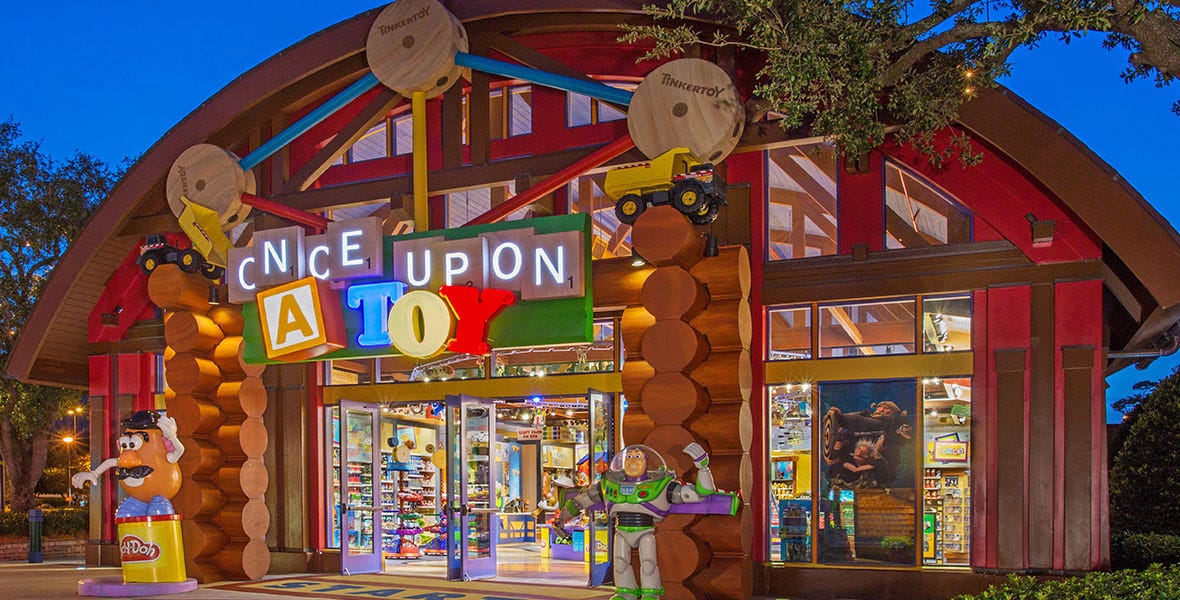
Collectibles alone grew 32%. Meanwhile plush toys and dolls, the classic little-kid categories, were among the steepest decliners.
Kidults now make up around 28% of global toy sales, up from 25.5% in 2022. And in a stat that says everything, the Toy Association found 81% of parents put toys for themselves on their holiday lists last year.
The toys are still selling. The buyers just grew up.
Hasbro said the quiet part out loud
Hasbro has been more honest about this than almost anyone.
CEO Chris Cocks told the Wall Street Journal that 40% of Hasbro’s customer base is now over 18. He’s talked openly about how other companies are only now “waking up to the power of the fans and the importance of the ‘kidult’ audience” Hasbro embraced years ago.
You can see it in what’s growing. G.I. Joe is back, driven by adult collectors. Magic: The Gathering had a record year. Hasbro Pulse, the direct-to-consumer store aimed squarely at collectors, was the company’s fastest-growing channel.
LEGO tells the same story — its share of sales from adults has quadrupled in under a decade, and it now runs an entire “Adults Welcome” section.
This isn’t a Disney quirk. It’s the whole industry re-pointing itself at people with credit cards and nostalgia.
The Disney Channel that made lifelong fans has collapsed
So why are the grown-ups suddenly load-bearing? Part of the answer is that the machine that used to manufacture new young Disney fans has fallen apart.
For decades, the Disney Channel was that machine. Appointment TV after school, the star factory that gave us Hannah Montana and a generation of kids who grew up fluent in Disney. In 2016, it averaged 1.316 million viewers a day.
By 2023, that was down to 132,000 — a 90% drop. Nickelodeon fell 86% over the same stretch; Cartoon Network, 85%.
Disney has since shut down its linear Disney Channel in more than 20 countries since 2019. Fewer than half of U.S. households even have traditional cable anymore.
The kids didn’t stop watching. They moved. Gen Alpha lives on YouTube and gaming now, not on a channel that tells them what’s on at 4 p.m. The old funnel that turned five-year-olds into forty-year-old annual passholders just doesn’t run the way it used to.
Why Disney put $1.5 billion into Fortnite
Which brings us to the strangest line item in Disney’s recent history.
In February 2024, Disney announced a $1.5 billion investment in Epic Games, taking an equity stake in the maker of Fortnite and committing to build a “persistent” Disney universe inside it. Bob Iger called it Disney’s biggest entry into gaming ever. The project is still being built, but the intent is plain.
Iger’s own reasoning, on the earnings call, was that younger audiences spend enormous amounts of time on screen-based platforms and games — so Disney needs to “meet more consumers where they are.”
Translated: if kids won’t come to the Disney Channel, Disney will go to where the kids already are, which is a battle royale shooter. Hasbro’s Chris Cocks pointed to the same research when explaining his own gaming push — for the next generation, the path to fandom now runs through a game first, a toy or a TV show second.
Toy Story 5 is literally a movie about a kid ditching her toys for a tablet
And then there’s the irony sitting right in Disney’s own summer tentpole.
Toy Story 5 opened June 19, 2026, and its villain isn’t a toy collector or an incinerator. It’s a tablet. An 8-year-old named Bonnie gets a frog-shaped smart device called Lilypad and starts ignoring Woody, Buzz, and Jessie entirely. “Toys are for play, but tech is for everything,” Woody says at one point, which is about as blunt a thesis as Pixar has ever written.
The research backs the plot. Kids ages 8 to 10 now average around four hours a day on screens, roughly double a decade ago. Gaming time among young kids surged 65% in four years. By age 4, nearly 60% of children have a tablet.
Here’s the part that’s hard to square. This is a Disney movie, from an increasingly digital Disney, warning parents about the exact devices pulling kids away from toys. And LeapFrog released an actual Toy Story 5-branded Lilypad tablet as a tie-in product. A film about a screen stealing a kid’s imagination, selling you a screen on the way out of the theater.
Make of that what you want.
Where this leaves Disney
Put it all together and the picture isn’t “Disney abandoned kids.” It’s messier and more interesting than that.
Disney still wants the next generation badly — that’s what the Fortnite billion is for. But reaching kids got harder and more expensive at the exact moment adults got more valuable, more loyal, and more willing to spend $75,000 on a duck pin. So the money follows the grown-ups, and the parks, the merch, and the collectibles quietly re-point themselves at people old enough to remember when Disney was just for kids.
The uncomfortable question underneath all of it: if the Disney Channel isn’t minting new little fans, and families are getting priced out of the parks, where does the next wave of Disney Adults come from?
Disney is betting a billion and a half dollars that the answer is a screen. We’ll find out if a kid raised on Fortnite skins grows up to buy the annual pass.
Article compiled with the help of the Pirates & Princesses newsroom.
Pirates and Princesses is your destination for Disney news, theme park updates, and the pop culture you love. From Disney cruises and travel tips to Disney fashion, food, collectibles, and movie news, PNP covers it all. Visit us at piratesandprincesses.net for daily coverage. Follow PNP on Facebook and Instagram, and listen to the Pirates & Princesses podcast on Apple Podcasts and YouTube.
Hat Tips:
Circana (Jan 27, 2026 report and 2025 data), adult/kidult toy sales figures — $9.1B adult spend, 28% global share, $45B U.S. market, collectibles +32%
TheWrap (2024), Disney Channel viewership collapse — 1.316M daily in 2016 down to 132,000, the 90% drop and cross-network comparisons
Variety and The Walt Disney Company (Feb 2024), the $1.5B Epic Games investment and Iger’s stated rationale
StreetLight Data / MatrixBCG, Disney World visitor demographics — the ~37% households-with-kids figure and adults-without-children share
Bloomberg / WARC, the Disney Adult subculture and the meet-and-greet stat
The Toy Book and License Global, Hasbro’s Chris Cocks on 40% adult customer base and the kidult strategy
CNN, NPR, and Salon (June 2026), Toy Story 5 plot, screen-time research, and the LeapFrog Lilypad tie-in
Multiple parks outlets (2026), corroborated Disney World 2026 ticket pricing — $119 floor, $209 Magic Kingdom peak, family-of-four day-rate math