

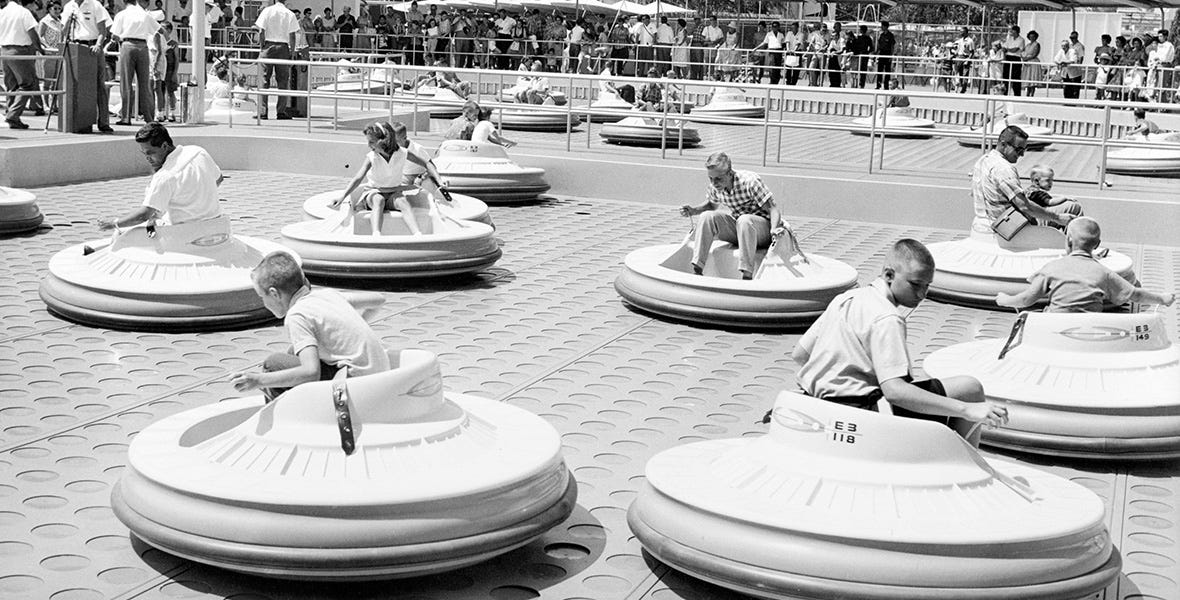
Disneyland’s Flying Saucers floated riders on jets of air from 1961 to 1966 and became “one of the worst maintenance headaches” in the park. Disney tried again in 2012 with Luigi’s Flying Tires. That one lasted less than three years.
In 1961 Disney opened a ride in Tomorrowland where you sat in a little saucer, floated a few inches off the ground on a cushion of air and steered by leaning. It was a giant air hockey table, and you were the puck.
It was also, per D23, “one of the worst maintenance headaches at Disneyland.“ The Flying Saucers closed after five summers.
Then, 46 years later, Disney rebuilt the same idea in Cars Land as Luigi’s Flying Tires. That one lasted two years and eight months.
How did Disneyland’s Flying Saucers work?
The floor did the work. The ride surface was a big blue oval split into two halves, each drilled with thousands of round air valves. Four 100-horsepower motors blew more than 300,000 cubic feet of air a minute up through the floor, per D23’s history of the ride.
When a saucer sat over a valve, the valve opened and lifted it.
The saucer itself had no engine, no controls and no moving parts. To steer, you leaned. Shift your weight and the saucer tipped, air escaped out one side and you drifted the other way.
Werner Weiss of Yesterland calls the whole setup “a colossal air hockey table,” which is exactly what it was.
The ride opened Aug. 6, 1961 and held one adult or two kids per saucer. Yesterland puts the fleet at 64 saucers in four groups of 16, with two groups riding while two loaded.
About a million people a year rode it.
Why did the Flying Saucers close?
They kept breaking. The air system was fussy, the saucers bumped and stalled, and loading was painfully slow because riders had to climb in one at a time while the floor was off.
Disney’s own A-to-Z entry uses the phrase “maintenance headaches,” and it closed on Sept. 5, 1966 to make room for the 1967 New Tomorrowland.
The infrastructure was built by Arrow Development, the company behind the Matterhorn and the Mad Tea Party. The saucer vehicles were designed by Imagineer Bob Gurr, who designed almost everything with wheels at Disneyland.
Arrow filed patents on the air-floor system through 1966. Nobody ever licensed it.
The site today is the Tomorrowland Stage area, not the Space Mountain queue, which is where some fan sites put it.
What was Luigi’s Flying Tires at Disney California Adventure?
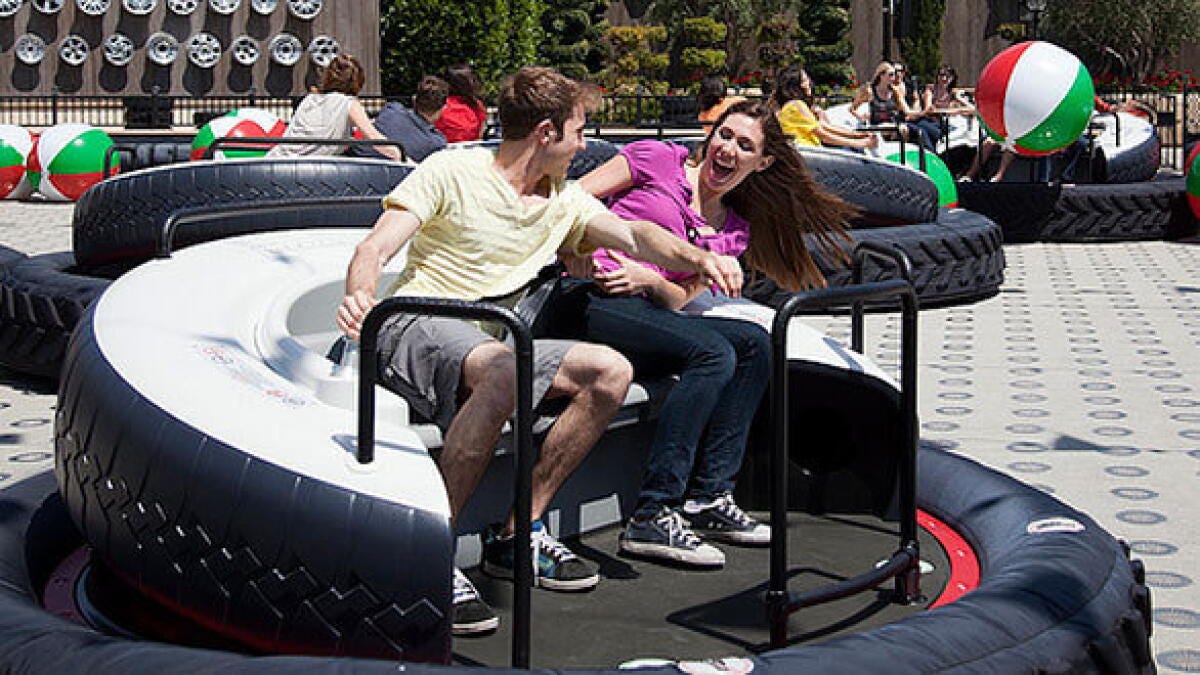
The same ride with tires instead of saucers. When Cars Land opened on June 15, 2012, one of its three attractions was Luigi’s Flying Tires: 21 oversized tires, three riders each, floating on an air floor in Luigi’s Casa Della Tires. You leaned to steer, same as 1961.
Disney threw in beach balls this time, so riders could bat them at each other while they drifted. That lasted about two months.
Why did Luigi’s Flying Tires close?
Same reasons, new decade. In August 2012 Disney pulled the beach balls. DCA vice president Mary Niven told MiceChat that guests slowed loading to grab balls and there had been “minor incidents” of people getting hit.
Disney also stripped about 20 pounds of leftover joystick hardware from each tire to make them move faster.
They still didn’t move much. Laughing Place’s verdict: “you really couldn’t move on those things.” WDWNT reported when the closure was announced that “Luigi’s Flying Tires never scored very well as far as guest satisfaction,” and that lines ran long for a ride most people couldn’t figure out.
Disney announced the end on Feb. 6, 2015, and the last day was Feb. 16, 2015. The ride had been open 977 days.
What replaced Luigi’s Flying Tires?
Luigi’s Rollickin’ Roadsters, which opened March 7, 2016 in the same building. It uses 20 trackless cars that dance to Italian music, and nobody has to steer anything. It’s a hit. It’s also an admission that the air floor was never going to work.
Will Disney ever try the air hockey ride again?
There’s no sign of it. Two attempts, 51 years apart, both closed for the same reasons: the air system is expensive, the loading is slow and most people can’t steer by leaning. That’s a pretty complete answer.
The 1961 saucers live on in a Disney Parks Blog vintage video and in the memories of Boomers who rode them as kids. The tires live on in a lot of 2013 blog posts titled “Why Won’t This Thing Move.”
Bob Gurr designed the Monorail, the Autopia cars, the Matterhorn bobsleds and the Haunted Mansion Doom Buggies. He also designed a saucer with no steering wheel. Even the greats have one.
Article compiled with the help of the Pirates & Princesses newsroom.
Pirates and Princesses is your destination for Disney news, theme park updates, and the pop culture you love. From Disney cruises and travel tips to Disney fashion, food, collectibles, and movie news, PNP covers it all. Visit us at piratesandprincesses.net for daily coverage. Follow PNP on Facebook and Instagram, and listen to the Pirates & Princesses podcast on Apple Podcasts and YouTube.
Hat Tips:
D23 (Flying Saucers and Luigi’s Flying Tires A-to-Z entries, and “Flying Back in Time with Disneyland’s Flying Saucers”), the dates, the motors and airflow figures, the ridership and the maintenance quote
Yesterland and MiceChat (Werner Weiss), the air-valve mechanism, the fleet count, Arrow Development and Bob Gurr, and the air hockey quote
MiceChat (Aug. 20, 2012), the beach-ball removal, the Mary Niven quotes and the joystick hardware
WDWNT (Oct. 2014), the guest satisfaction quote and the closure announcement
Behind the Thrills (Feb. 6, 2015), the Feb. 16, 2015 final day
Laughing Place (Disney Extinct Attractions), the steering verdict
Disney Parks Blog (Feb. 2016), the Luigi’s Rollickin’ Roadsters opening and vehicle count
AI Disclosure: All articles are assigned, edited and reviewed by an experienced human editor before posting. Like most modern newsrooms, WebReef Media uses a variety of AI tools to help with accuracy and efficiency. Ways AI may be used in article creation include research, grammar, fact-checking and ideation, as well as occasional AI generated or enhanced thumbnails or graphics. No articles are generated or posted without human oversight or involvement.