

A Disney patent application published August 20 describes warning guests before moments they’ve flagged as unpleasant, like sudden drops or flashing lights. The same system could also increase G-forces for guests who want a rougher ride.
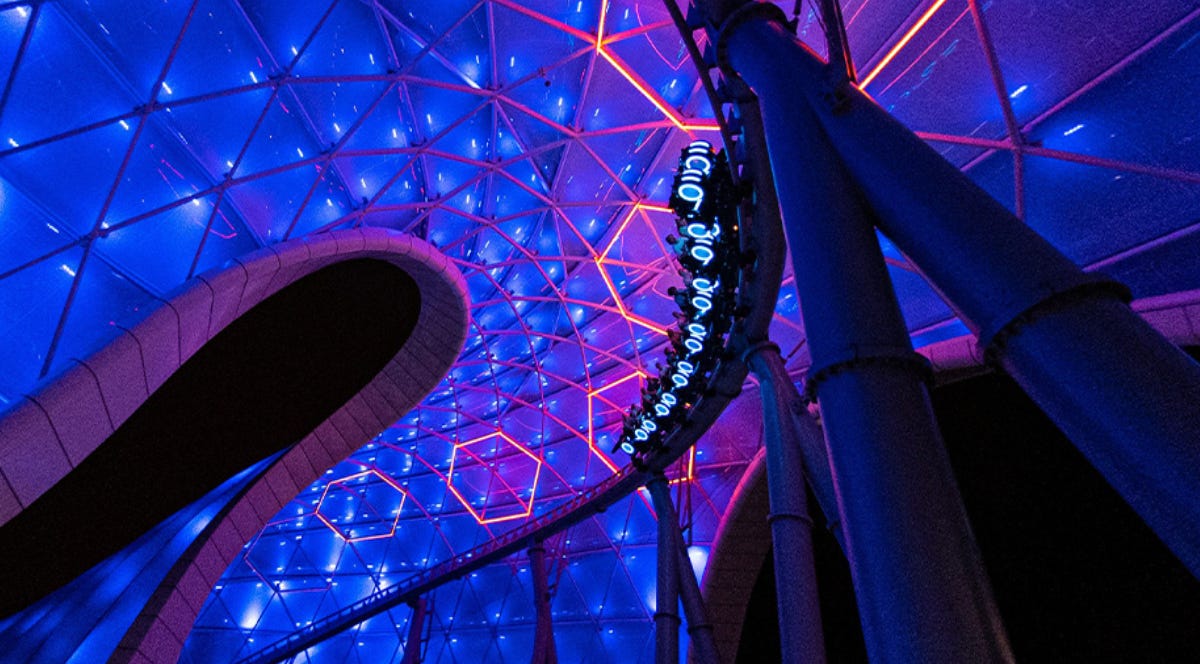
Disney has filed for a system that would tell you the drop is coming.
A patent application titled “Personalized Notification of Attractions Including User Preferences or Aversions” was published by the U.S. Patent and Trademark Office on August 20. Disney Enterprises filed it on February 14, 2025.
The described system learns what a guest enjoys and what makes them uncomfortable, then warns them in real time before a flagged moment arrives. Sudden drops. Flashing lights. Dark scenes.
On compatible attractions, it goes further and changes the ride itself.
The system could send instructions to an attraction asking that an effect be increased, decreased, or removed entirely for one specific rider. Disney’s own example uses an individually controlled flight or space simulator, the kind of ride vehicle where each cabin operates on its own.
A guest who hates abrupt altitude changes could have them softened or cut. Someone who wants more could have the G-force increased, within predetermined safety limits.
Loud sounds turned down for one person. Bright lighting dimmed for another. More intensity for the guest who came looking for it.
Personalization in this patent runs both directions, which is a considerably more interesting idea than a warning label.
This is an application, not a finished product.
What published on August 20 is a patent application. The USPTO publishes applications roughly 18 months after filing, well before any decision on whether to grant them.
Disney files a large volume of these every year. Most never become anything a guest encounters. Recent examples include an AI restraint-checking system, an elevation illusion for flat ride paths, and a vanishing projection surface. None of those are in a park.
An application shows what Imagineering is thinking about. It does not show what is being built.
Fans have practical objections
The reaction from parks regulars has been mixed, and some of the pushback is reasonable.
The main concern is the phone. A warning system delivered to a mobile device means holding that device during the ride, which invites two problems. Guests watching a screen for an alert are not watching the attraction they paid for. And phones held during Tiana’s Bayou Adventure or Big Thunder Mountain tend to end up somewhere other than in the guest’s hand.
Others argue more bluntly that anyone who needs advance warning about a cannon blast might simply skip that ride.
Disney’s patent does not specify a delivery method in the coverage available, so how a warning would actually reach a rider remains open.
The accessibility case is stronger than the skeptics allow
There is a real argument on the other side, and it has nothing to do with being easily frightened.
Guests with sensory processing differences, PTSD, epilepsy, or severe anxiety navigate parks with genuine constraints, and strobe effects or unexpected loud noises are not a matter of nerve. Disney already publishes sensory experience details for attractions covering things like flashing lights and loud sounds, precisely because that information matters to a portion of its audience.
A system that flags a specific moment, or removes a strobe for one rider, is an extension of accessibility work Disney is already doing rather than a departure from it.
Whether it belongs on a phone is a fair question. Whether the underlying need exists is not really in dispute.
What happens next
Nothing announced, and probably nothing soon.
No attraction has been identified, no timeline exists, and the application still has to work through the patent process. The technology as described would require attractions capable of individual guest adjustment, which most are not.
Disney has spent this month talking about personalization across its parks and streaming products. This one is a filing from early last year that happened to surface now. Somewhere in Glendale, someone has already moved on to the next idea.
Article compiled with the help of the Pirates & Princesses newsroom.
Pirates and Princesses is your destination for Disney news, theme park updates, and the pop culture you love. From Disney cruises and travel tips to Disney fashion, food, collectibles, and movie news, PNP covers it all. Visit us at piratesandprincesses.net for daily coverage. Follow PNP on Facebook and Instagram, and listen to the Pirates & Princesses podcast on Apple Podcasts and YouTube.
Hat Tips:
Attractions Magazine (August 20, 2026), the patent application title, the February 14, 2025 filing date, the August 20 publication, the effect-adjustment details, and the G-force and simulator examples
WDWMagic (August 20, 2026), the original report on the patent and the guest warning capability
WDWMagic forums (August 20, 2026), park fan reaction, engagement not independently verified
AllEars.Net and Inside the Magic (2026), recent Disney patent applications including the restraint system, the elevation illusion, and the ride vehicle control filing