

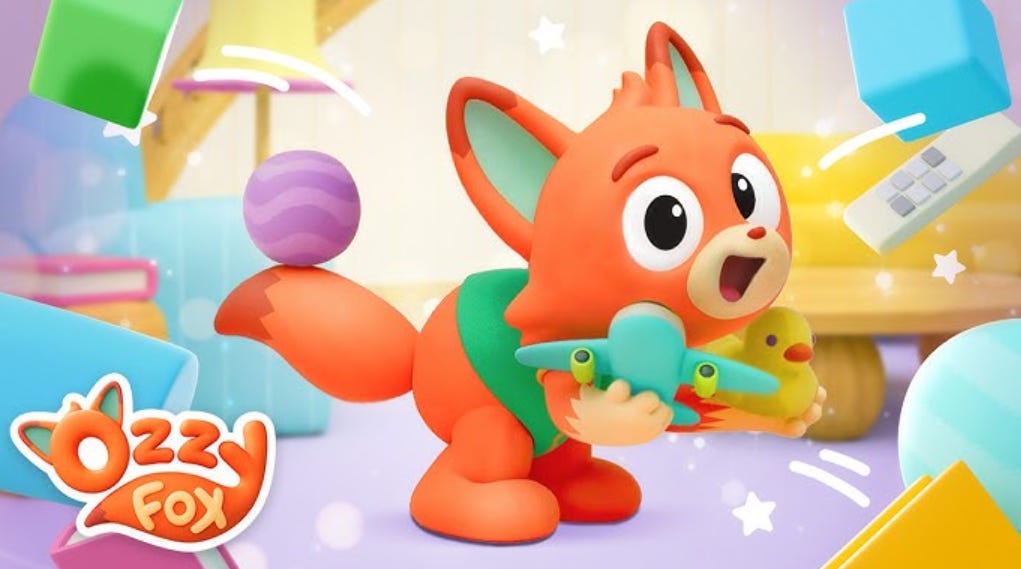
Ozzy Fox hit YouTube and YouTube Kids this week and pulled nearly 800,000 views in two days. Disney Jr made it with Animaj, a studio built around AI animation tools. Neither company will say how much AI is in it. The kids watching haven’t asked.
Ozzy Fox premiered this week on YouTube and YouTube Kids. Two episodes so far, about a five-year-old fox and his little sister turning ordinary days into adventures.
It’s pulled nearly 800,000 views in two days.
It’s also Disney Jr’s first preschool series made for YouTube, and it was built with Animaj, a studio whose entire pitch is AI-assisted animation.
Nobody will say how much AI is in it
That’s the actual news here.
Cartoon Brew put it plainly: “Neither company has explained what role Animaj’s AI tools played in making Ozzy Fox, although that kind of disclosure feels less and less common as AI tools become more commonplace in studio pipelines.”
Disney didn’t announce this show. It just appeared. No press release framing it as a milestone, no note about the pipeline, nothing.
What Animaj’s AI actually does
Worth being precise, because “AI cartoon” conjures something this isn’t.
Animaj’s tool does in-betweening. An artist draws the key poses, the AI generates the frames connecting them, and then the artist goes back in and corrects it, moving an arm here, a leg there.
The payoff, per Animaj CEO Sixte de Vauplane: “Thanks to this tool, it takes less than five weeks to produce a 5-minute-long episode, whereas it used to take five months.”
In-betweening is the most repetitive job in animation. It’s what junior animators grind through and what studios have outsourced overseas for forty years. Automating it isn’t the same as typing a prompt and getting a fox.
This is not, in other words, the three-tails-and-seventeen-fingers stuff.
The people behind it are real animators
Ozzy Fox was created by Jennifer Oxley, who made Peg + Cat. It was developed by Guillermo García-Carsí, who created Pocoyo.
Those aren’t content-farm names. Those are people with Emmys.
Animaj itself was co-founded in 2022 by former YouTube Kids exec Gregory Dray, bought Pocoyo from Zinkia in 2023, raised $85 million led by HarbourView Equity Partners and France’s Bpifrance, took $1 million from Google, and got picked for the Disney Accelerator in 2025. Disney invested in them before it hired them.
Animaj’s argument: fight the slop
The studio has publicly defended using AI for children’s content, and urged other studios to do the same, specifically to compete with “AI slop being made in unregulated content farms.”
That’s a real argument. Kids’ YouTube is already drowning in generated garbage. If that’s the competition, a studio using AI to make more content with actual animators supervising it is arguably the good outcome.
You don’t have to buy it to notice it’s coherent.
The kids don’t care
Here’s the part that settles it.
Eight hundred thousand views in two days, from an audience that has never once asked how something was made.
Look at Italian brainrot. Tralalero Tralala. Bombardiro Crocodilo. Ballerina Cappuccina. Pure AI-generated nonsense, no humans involved in any meaningful sense, and kids consume it by the hour and adore it. There is no version of a four-year-old clocking a rendering pipeline.
Compare that to adults. Games on Steam, where AI disclosure is mandatory, have reportedly lost up to 53% of revenue once players see the tag.
Adults punish disclosure. Kids don’t have the concept.
Which is why the silence matters
That’s the whole thing, and it isn’t really about Ozzy Fox, which by all appearances is a normal cartoon made by good people using a tool that automates tweening.
It’s that the audience with the least ability to evaluate what it’s watching is the audience getting the least information about it. There’s no disclosure penalty in preschool, so there’s no incentive to disclose, so nobody does.
The parents might want to know. Nobody asked them either.
Article compiled with the help of the Pirates & Princesses newsroom.
Pirates and Princesses is your destination for Disney news, theme park updates, and the pop culture you love. From Disney cruises and travel tips to Disney fashion, food, collectibles, and movie news, PNP covers it all. Visit us at piratesandprincesses.net for daily coverage. Follow PNP on Facebook and Instagram, and listen to the Pirates & Princesses podcast on Apple Podcasts and YouTube.
Hat Tips:
C21Media and Cartoon Brew (July 2026), verified Disney Jr launching Ozzy Fox, its first preschool series for YouTube, developed in partnership with France- and UK-based AI animation studio Animaj, premiering this week on YouTube and YouTube Kids with the first two episodes available, created by Jennifer Oxley of Peg + Cat and developed by Pocoyo creator Guillermo García-Carsí, following a five-year-old fox and his family, drawing nearly 800,000 views in its first two days, and Cartoon Brew’s observation that neither company has explained what role Animaj’s AI tools played in making the series “although that kind of disclosure feels less and less common as AI tools become more commonplace in studio pipelines”
C21Media and CNET (via AOL) (2025-2026), verified Animaj’s background and technology — the Paris- and London-based studio co-founded in 2022 by former YouTube Kids executive Gregory Dray, its acquisition of Pocoyo from Spain’s Zinkia Entertainment in 2023, its $85 million funding round led by HarbourView Equity Partners and Bpifrance, a subsequent $1 million from Google, its selection for the Disney Accelerator program, its AI-assisted sketch-to-pose and motion in-betweening pipeline used on Pocoyo and Maya the Bee, CEO Sixte de Vauplane’s statement that the tool cuts production of a five-minute episode from five months to under five weeks, the workflow in which artists correct AI-generated animation, and Animaj’s public defense of using AI for children’s content while urging other studios to do the same to combat “AI slop being made in unregulated content farms”
MobileSyrup (July 2026), verified the reported figure that games disclosing generative AI use on Steam, where disclosure is mandatory, have lost up to 53% of revenue