

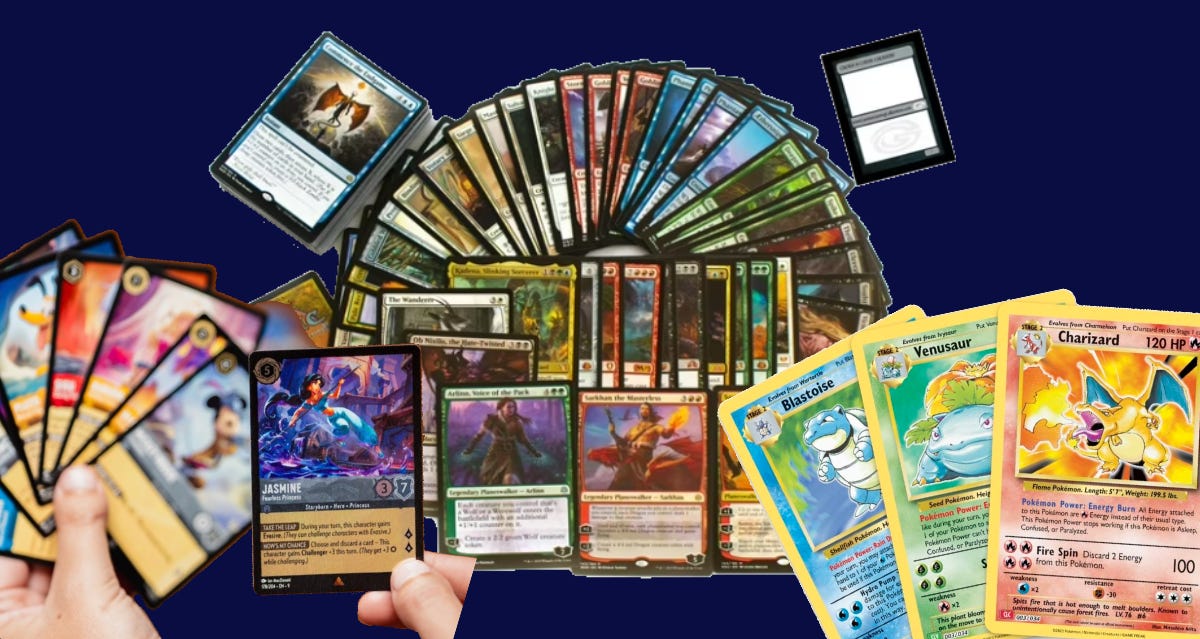
Pokémon prints ten billion cards a year and its prices have started to crash. Magic prints fewer and holds value. Lorcana did $100 million in 18 months, then cooled. Here is what separates them.
Three trading card games dominate the shelf at your local game store, and they are not competing on the same axis at all.
Pokémon wins on volume. Magic: The Gathering wins on stability. Disney Lorcana built the fastest ramp any Disney product has ever managed, then had to prove it was not a fad.
The global trading card game market was valued at $8.4 billion in 2025 and is projected to reach $16.9 billion by 2035. All three are growing. They are growing very differently.
How big is each card game
Market share figures vary enough that you should treat any single number carefully.
PreGradeCards puts Pokémon at roughly 12 percent of the total TCG market, calling it the largest single brand. PokemonPricing puts The Pokémon Company at 21 percent.
That gap likely reflects different definitions of what counts as the market and whether Japanese sales are included. Both agree Pokémon is first.
Magic: The Gathering cleared $500 million in a single quarter’s revenue this year, a first for the brand.
Disney Lorcana passed $100 million in sales within 18 months of its August 2023 launch, which Ravensburger described as the fastest ramp of any Disney product.
Why Pokémon cards crashed in 2026
The Pokémon Company printed 10.2 billion cards in a single 12-month period. Total production has passed 75 billion cards through March 2025.
Prices fell in 2026 anyway. Not from weak demand, but from saturation. When the base product is that abundant, value depends entirely on secondary demand, and secondary demand is fickle.
PokemonPricing documented the mechanism: a celebrity opening packs on YouTube can spike prices 30 to 40 percent in weeks. When the hype cycle ends, those cards fall just as fast.
Pokémon’s high-end cards, the Secret Rares with high-gloss UV finishes, still command the strongest secondary values in the hobby. The floor underneath them is just less stable than it looks.
Why Magic cards hold value better
Wizards of the Coast does the opposite of what Pokémon does.
Magic’s print runs are not published, but analysis from MTGStocks indicates newer sets receive smaller runs than older ones. Special products including Collector Boosters and Secret Lairs are deliberately limited.
A Magic booster pack costs roughly what a Pokémon pack costs. Magic singles cost more, because the supply behind them is smaller.
The result is a market described as having a healthy year, with competitive play surging and collector box demand recovering. That movement traces to gameplay and collectibility rather than viral moments.
Magic also owns the tournament infrastructure. The Pro Tour circuit has no real equivalent in either competitor, and that ecosystem gives cards a floor of actual play demand rather than pure speculation.
What makes Disney Lorcana different
Lorcana entered as the least likely of the three to work.
Ravensburger was known as a puzzle company. The TCG community was openly skeptical that a puzzle manufacturer could handle card game distribution, which is a genuinely difficult logistics problem.
It worked. Lorcana bridged two audiences that rarely overlap: competitive card players and Disney collectors who had never bought a booster pack.
The physical product reflects that. Lorcana uses a matte and satin card finish rather than the high-gloss look of Pokémon and the anime-derived games, which reads as more adult and has drawn an older demographic.
Did Disney Lorcana peak
Sales fell in 2025 after the launch surge, and Ravensburger addressed it directly.
The company said Lorcana developed from its 2023 debut into a sustainable business segment and a long-term pillar of its portfolio, and has expanded the property into puzzles and books.
That is corporate language for settling at a lower but durable level after the initial frenzy.
Then it moved again. In June, retailer Card Horizon reported a significant spike in Lorcana sales volume, describing buyout activity of the kind usually reserved for high-end Pokémon sets.
TCGplayer’s second-quarter data noted that the top card in a recent Lorcana set trades in four figures, which the marketplace framed as confidence in the game’s long-term position.
Whether that spike is organic growth or speculators moving in is an open question, and Card Horizon raised it themselves.
Which card game is best for competitive play
Magic, without much argument.
The strategic depth is the deepest of the three, the format variety is the widest, and the Pro Tour structure means there is an actual professional ceiling.
Pokémon runs a substantial organized play program with regional and world championships. Lorcana has built its competitive scene from a standing start in three years, which is fast, but it is not yet comparable.
Which card game is best for collectors
This depends on what you want from collecting.
Pokémon offers the highest ceilings and the widest recognition. A graded Pokémon card is liquid almost anywhere in the world. It also carries the most volatility.
Magic offers the most stability and the deepest history, with a thirty-year back catalog and a market that responds to gameplay rather than trends.
Lorcana offers the shortest history and therefore the most uncertainty, alongside a genuine advantage: every card features Disney characters, which gives it appeal to people who will never play a game with it.
What else is happening in the card game market
The Big Three are no longer alone, and one competitor keeps outperforming.
The One Piece Card Game, launched in 2022, now generates over $200 million annually. Booster boxes for its first set have appreciated more than 400 percent.
For the third consecutive quarter, One Piece outsold one of the Big Three on TCGplayer.
Yu-Gi-Oh! grew in the second quarter on the strength of Rarity Collection V, which introduced extended-art cards to that game for the first time.
Other entrants, including Star Wars: Unlimited, Altered, and Flesh and Blood, have all launched into this market in recent years.
One practical note for buyers
Japanese releases lead English releases by four to six months across most of these games.
That gap creates a window where card values are established in one market before the other catches up, which experienced collectors watch closely.
Where Wizards of the Coast sits right now
The company behind Magic has had a turbulent year despite the revenue.
John Hight departed as president of Wizards of the Coast on Sept. 1. Hasbro CEO Chris Cocks, himself a former Wizards president, took direct control of the division.
Hasbro also recorded a $56 million impairment tied to the segment.
Magic cleared its half-billion-dollar quarter in the middle of that, which is the clearest signal available that the game itself is healthy regardless of what happens above it.
All figures cited are current as of September 2026 and card game markets move quickly.
Article compiled with the help of the Pirates & Princesses newsroom.
Pirates and Princesses is your destination for Disney news, theme park updates, and the pop culture you love. From Disney cruises and travel tips to Disney fashion, food, collectibles, and movie news, PNP covers it all. Visit us at piratesandprincesses.net for daily coverage. Follow PNP on Facebook and Instagram, and listen to the Pirates & Princesses podcast on Apple Podcasts and YouTube.
Hat Tips:
PokemonPricing (April 2026), the 10.2 billion card production figure, the 75 billion total, the influencer price mechanism and the Magic print run analysis via MTGStocks
PreGradeCards (June 2026), the global market valuation, the CAGR projection, the market share figure and the One Piece revenue
BoardGameWire (January 2026), Ravensburger’s statement on Lorcana’s 2025 sales decline and its portfolio position
TCGplayer (July 2026), the Q2 best-selling data, the One Piece streak and the Lorcana four-figure card note
Card Horizon (June 2026), the Lorcana sales spike and the speculation question
QP Market Network (March 2026), the card finish comparison and the Lorcana demographic analysis