

The filing Theme Park Insider flagged Friday is a follow-up. Disney already won a patent on the same idea Aug. 25, and its researchers showed it off in 2024 on a 2-foot-9 robot named LIME.
Disney wants robots that can copy an animator's moves without falling on their faces, and it has the patent paperwork to show for it.
Theme Park Insider's Robert Niles flagged the filing Friday morning, Nov. 6, under the headline "Can a cartoon train a robot? Disney hopes so." It's called "Versatile Motion Priors for Artist-Directable Physical Characters," and the U.S. Patent and Trademark Office published it on Nov. 5.
It isn't Disney's first swing at this, though. The new application is a continuation of one Disney filed May 10, 2024, which became U.S. Patent 12,715,114 on Aug. 25, 2026. Disney Enterprises and ETH Zurich, a Swiss university, are the applicants.
The research behind it is older still. Disney Research presented it at the Symposium on Computer Animation in August 2024, with a working robot.
Here's Disney Research's video on the technique:
What does Disney's robot motion patent do?
It's a two-step translator between animation and real-world physics. The patent's background section puts the problem simply: "animated characters do not always follow the laws of physics."
Step one: Software studies a big library of motion clips and learns a kind of shorthand for how bodies move. The technical name is a variational autoencoder.
Step two: A control program practices in a simulator, by trial and error, until it can turn that shorthand into motor commands. That's called reinforcement learning.
The result: An animator hands the system a new move, and the robot performs the closest version it can manage while staying balanced.
The selling point is speed. One trained controller handles new animations without retraining, so new moves can go to robots "quickly and efficiently," the filing says.
Did Disney actually train a robot with cartoons?
Not exactly. The 2024 paper trained the system on about 11 hours of motion, mostly human. The biggest chunk, 8.5 hours, came from Carnegie Mellon University's motion capture library. The rest were animation clips from Reallusion and Mixamo.
The patent says training data can be "artist-created or motion captured." It doesn't name a movie or a character. "Cartoon" is Theme Park Insider's shorthand for artist-made animation.
Disney's researchers did ask an artist to make a dance for testing. The animation had the usual foot sliding, and the system cleaned it up while following the moves, the paper says.
What robot did Disney test it on?
A two-legged robot called LIME. It stands about 2 feet 9 inches tall and weighs about 36 pounds, with 20 motorized joints, according to the paper.
LIME has no motor to roll its ankle, so it can't balance on one foot for long. When a dance asked it to, the controller tapped the robot's toe on the floor to stay upright. Honestly, same.
The paper's authors are Agon Serifi, Ruben Grandia, Espen Knoop, Markus Gross and Moritz Bacher of Disney Research in Switzerland and ETH Zurich. All but Gross are named inventors on the patent.
Could this power robot characters at Disney parks?
Maybe someday, but Disney hasn't said so. The filing says copying a character's style matters "where autonomous robots are provided for specific characters," including the way a character walks. It doesn't name a park, a ride or a character.
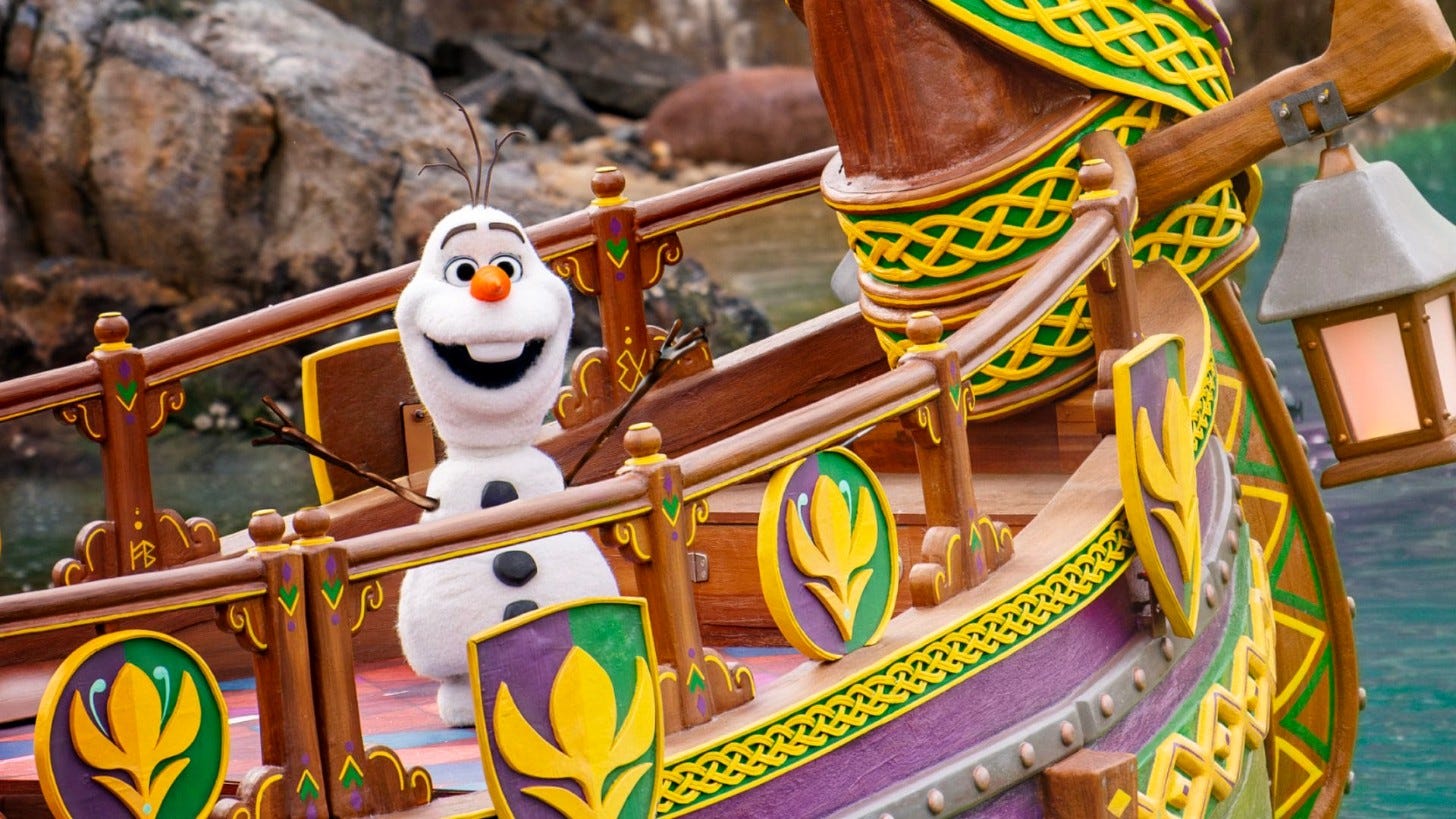
Disney already has walking robot characters. Theme Park Insider pointed to the BDX droids in Star Wars: Galaxy's Edge at Disneyland and the Olaf robot in the World of Frozen lands in Hong Kong and Paris.
In March, Imagineering said Olaf learned to balance on a boat through reinforcement learning in simulation. "In just a matter of hours, he earned his sea legs," Imagineering senior vice president Kyle Laughlin said, WDWNT reported.
Disney hasn't said whether this exact method runs any of those robots. A patent is a legal claim on an idea, not a product announcement.
What other Disney robot and AI news is there?
It's been a busy fall. The AI character patents we covered Oct. 25 turned out to date back to 2023 filings. And on Nov. 4 we covered Disney Accelerator Demo Day, where startups showed robots for backstage jobs like collecting and arranging 3D glasses for cleaning.
Theme Park Insider also points readers to Niles' earlier hands-on look at how Disney's Olaf works, from a visit to Imagineering's Glendale headquarters.
Article compiled and written by Kambrea Pratt (editor-in-chief), Derek Gibbs (beat editor) and the Pirates & Princesses newsroom. Pirates & Princesses is part of WebReef Media.
Pirates and Princesses is your destination for Disney news, theme park updates, and the pop culture you love. From Disney cruises and travel tips to Disney fashion, food, collectibles, and movie news, PNP covers it all. Visit us at piratesandprincesses.net for daily coverage. Follow PNP on Facebook and Instagram, and listen to the Pirates & Princesses podcast on Apple Podcasts and YouTube.
Hat Tips:
Theme Park Insider (Nov. 6, 2026), the tip, the patent link and the BDX and Olaf context
U.S. Patent and Trademark Office (Nov. 5, 2026), application US 2026/0346432: title, applicants, inventors, abstract, background and filing history
U.S. Patent and Trademark Office (Aug. 25, 2026), U.S. Patent 12,715,114, the earlier grant on the same invention
Disney Research (Aug. 15, 2024), the VMP paper and video: authors, dataset, LIME robot specs and the artist-made dance test
WDW News Today (March 16, 2026), how Imagineering trained Olaf and Kyle Laughlin's quote
AI Disclosure: All articles are assigned, edited and reviewed by an experienced human editor before posting. Like most modern newsrooms, WebReef Media uses a variety of AI tools to help with accuracy and efficiency. Ways AI may be used in article creation include research, grammar, fact-checking and ideation, as well as occasional AI generated or enhanced thumbnails or graphics. No articles are generated or posted without human oversight or involvement.