

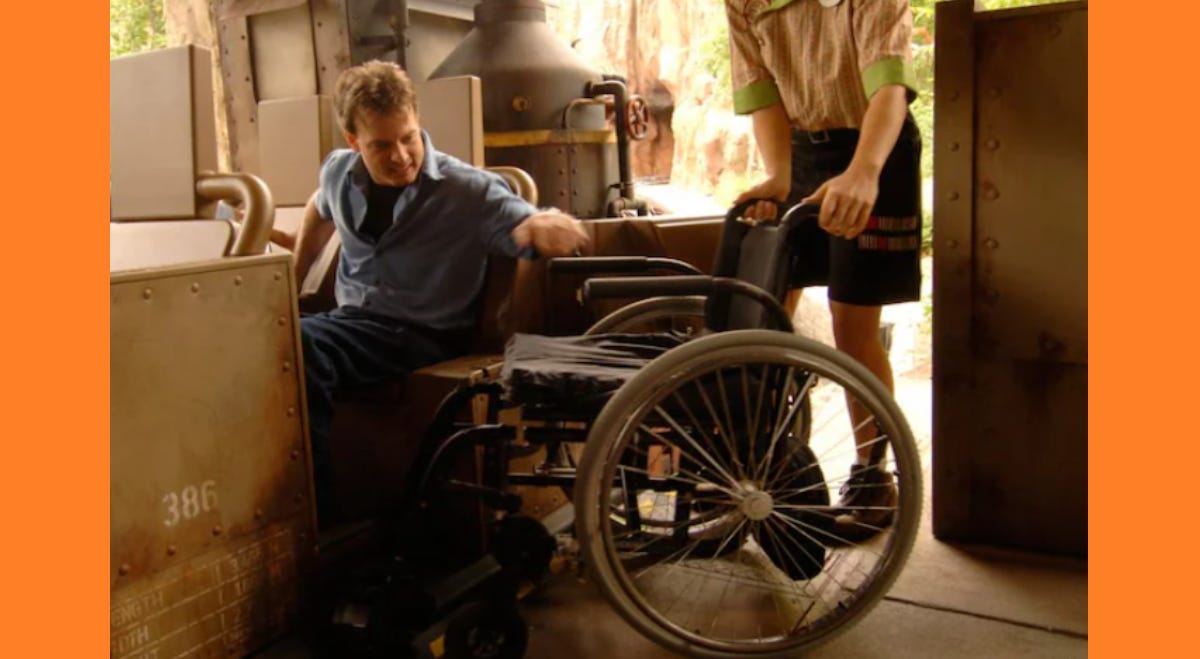
A filing published this week describes a ride platform that tilts itself to stay level while the vehicle moves. No project is attached to it, but the idea is a big one.
Disney has patented something that would matter to a lot of guests if it ever gets built.
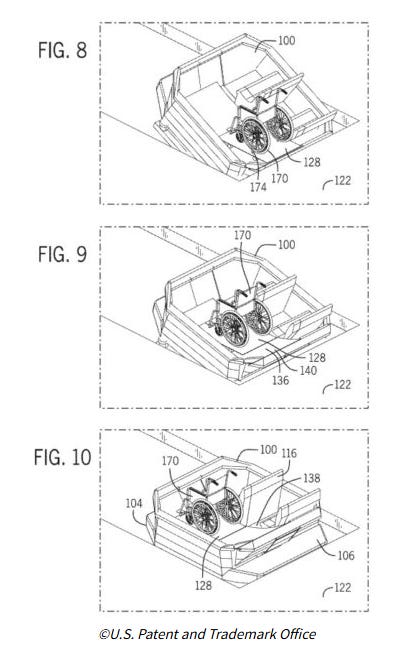
The filing published Sept. 17 is titled “Rider Inclusive Transport Aide.” It describes a ride vehicle platform that carries a wheelchair or electric scooter directly, without asking the rider to get out and move to a seat.
Disney filed it on March 11, 2025. .
What does Disney’s wheelchair ride patent describe?
A platform that corrects itself.
The core idea is a moveable surface that counter-adjusts against the ride vehicle’s own motion. When the vehicle tips, banks, or climbs, the platform rotates the other way to keep whatever is sitting on it level. A mobility device stays flat and stable even when the ride around it is not.
Plenty of attractions could physically fit a wheelchair. Far fewer can keep one safe through the tilting and pitching that make a ride interesting.
As long as it doesn’t fail.
Transfers take time, and a transfer stop can hold a loading area while everyone behind it waits. A system that skips the transfer entirely would cut loading times, and lines could move faster.
Does a Disney patent mean it is being built?
No.
Disney files patents constantly. Most never become anything. The company has patented everything from floating projection screens to drone light shows to robots that do backflips, and a good share of those filings exist to protect an idea rather than to schedule a project.
No attraction is attached to this one. No park, no timeline, no budget, no announcement. What exists is a document describing how such a system could work, filed by a company that wants to own that description.
It’s an idea in development.
Why transfers are a problem at Disney World
Because they exclude people, and they do it quietly.
Most Disney attractions that accommodate wheelchairs do it one of two ways. Either the guest transfers to a standard seat, which many people cannot do at all, or the ride has a dedicated accessible vehicle with a ramp, which usually means waiting for that specific car to come around.
Both approaches work better than nothing. Both also put the burden on the guest, and both shape what a family can realistically do in a day. A party that has to plan around transfer capability rides a different park than one that does not.
A platform that carries the chair itself would change the math on which attractions are even possible.
What Disney offers wheelchair and ECV users now
The current system is a mix.
Several attractions have wheelchair-accessible vehicles, including the Haunted Mansion’s Doom Buggies with a modified car, Living with the Land, The Seas with Nemo and Friends, Kilimanjaro Safaris and the Disney Skyliner. Disney publishes transfer requirements for every attraction on its site and in the My Disney Experience app, listed by ride.
The Disability Access Service program handles queue accommodation separately, and Disney tightened its eligibility rules in 2024 to focus on developmental disabilities including autism.
Guests who want to check before a trip can pull up each attraction’s page, which spells out whether a transfer is required and what kind.
Disney has been quieter about accessibility technology than about most things it builds. A patent is not a promise. It is at least a sign somebody is working on the problem.
Article compiled with the help of the Pirates & Princesses newsroom.
Pirates and Princesses is your destination for Disney news, theme park updates, and the pop culture you love. From Disney cruises and travel tips to Disney fashion, food, collectibles, and movie news, PNP covers it all. Visit us at piratesandprincesses.net for daily coverage. Follow PNP on Facebook and Instagram, and listen to the Pirates & Princesses podcast on Apple Podcasts and YouTube.
Hat Tips:
WDW News Today, the patent publication, the “Rider Inclusive Transport Aide” title, the March 11, 2025 filing date and the self-leveling mechanism
Blog Mickey, parallel reporting describing the tilting platform system and the absence of a transfer platform
AI Disclosure: All articles are assigned, edited and reviewed by an experienced human editor before posting. Like most modern newsrooms, WebReef Media uses a variety of AI tools to help with accuracy and efficiency. Ways AI may be used in article creation include research, grammar, fact-checking and ideation, as well as occasional AI generated or enhanced thumbnails or graphics. No articles are generated or posted without human oversight or involvement.