

George Lucas says he retired with three more Star Wars films left in him. He wrote treatments for all three, sold them to Disney in 2012, and Disney used almost none of it.
George Lucas just put a number on what the world missed.
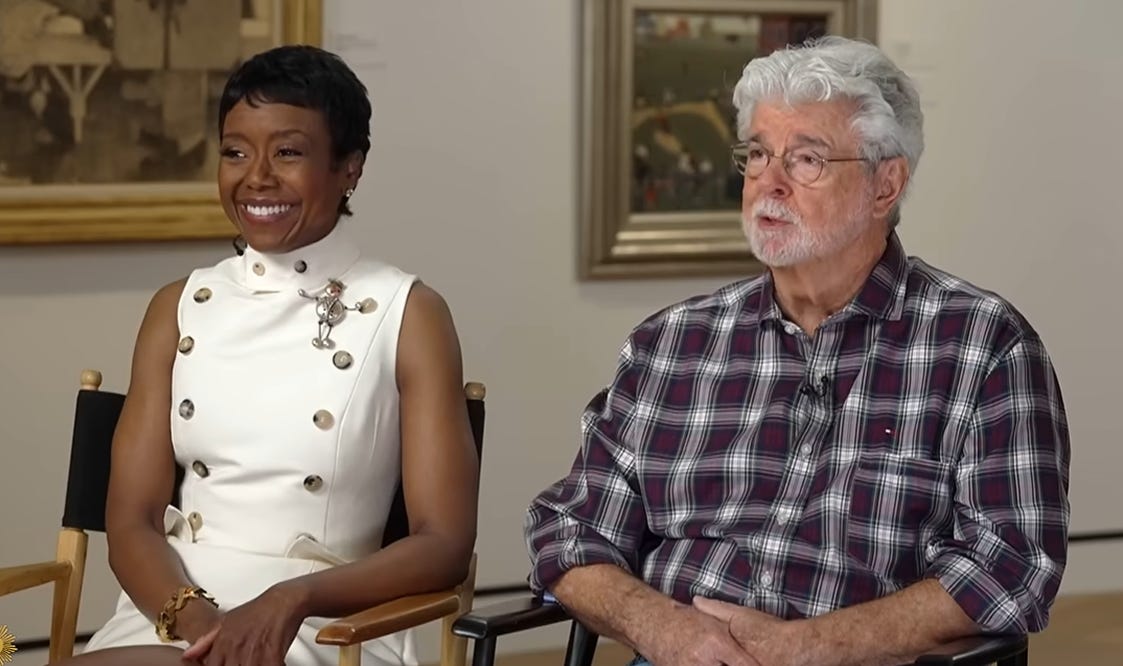
Talking to CBS Sunday Morning about the museum he spent a decade building, the 82-year-old filmmaker mentioned, almost in passing, that walking away from movies cost him a trilogy.
“I’m 82, so there is a limit,” Lucas told Norah O’Donnell in an extended interview posted Sunday. “When I did [the museum], I decided to retire from making movies, which was a big deal because I had three more Star Wars to make.”
Here’s the part that stings for fans. Those three movies weren’t a daydream. He wrote them down.
What were George Lucas’s three Star Wars movies?
Lucas wrote story treatments for Episodes VII, VIII and IX, and he handed them to Disney as part of the sale in October 2012. Disney bought the company for roughly $4 billion, and the treatments came with it.
From accounts published since, his version of the sequels included:
Luke Skywalker in self-imposed exile, hiding out near the first Jedi temple
A teenage girl training as a Jedi, the character who eventually became Rey
A young man who breaks away from the stormtroopers, the seed of Finn
Darth Maul, alive, running a criminal syndicate, with metal legs
Darth Talon, a female Sith he trains as an apprentice
Leia rebuilding the Republic while fighting off gangsters
And one idea that was pure Lucas. He wanted to go microscopic, digging into midi-chlorians and the Whills, which he has described as beings that feed off the Force and effectively run the universe.
That last one tends to split a room.
Did Disney use George Lucas’s Star Wars treatments?
Almost none of it.
Disney bought the treatments and then set them aside. Bob Iger wrote about the moment in his 2019 memoir, and he doesn’t dress it up.
“George knew we weren’t contractually bound to anything, but he thought that our buying the story treatments was a tacit promise that we’d follow them,” Iger wrote, “and he was disappointed that his story was being discarded.”
Iger has said he broke the news at Skywalker Ranch, and that J.J. Abrams and screenwriter Michael Arndt would be building their own story instead.
“George felt betrayed,” Iger wrote, “and while this whole process would never have been easy for him, we’d gotten off to an unnecessarily rocky start.”
He also admitted he fumbled the delivery. “I’d been so careful since our first conversation not to mislead him in any way, and I didn’t think I had now, but I could have handled it better.”
Iger’s own words about not being contractually bound does sound like maybe Lucas was misled, but I digress.
What did George Lucas say about The Force Awakens?
He wasn’t shy.
In a 2015 interview with Charlie Rose, not long after the movie opened, Lucas said Disney had gone backward on purpose.
“They wanted to do a retro movie,” he said. “I don’t like that. Every movie, I work very hard to make them different. I make them completely different, with different planets, with different spaceships, to make it new.”
In the same conversation, he compared selling the company to a divorce. That interview also produced a remark he apologized for within days, and he has been noticeably more measured about Disney in the years since.
Did any of Lucas’s ideas make it into the movies?
A few did, and that’s the strange part.
The Force Awakens and The Last Jedi ended up with Luke living alone in exile near an ancient Jedi site. They built the trilogy around a young woman discovering she’s strong with the Force. They gave her a defector from the stormtroopers as a partner.
Those shapes were in Lucas’s outlines. The specifics went out the window, but the skeleton walked.
What never showed up was the rest. No Darth Maul. No Darth Talon. No trip inside the Force to meet the Whills.
Why did George Lucas stop making movies?
Because he ran out of road, and he’d rather build the museum.
“I realized that I was running out of time, and I did want to make this museum,” he told CBS.
That project is finished now. The Lucas Museum of Narrative Art opened to the public in Los Angeles on Tuesday, a 300,000 square foot building in Exposition Park designed by architect Ma Yansong. It holds more than 1,300 works, from cave-painting reproductions to Norman Rockwell and Frida Kahlo, plus his own archives, 30,000 comic books and Joseph Campbell’s personal library.
So the trade was three Star Wars movies for a museum full of the art that made him want to tell stories in the first place. Put that way, it’s hard to call it a bad deal.
Will anyone ever make Lucas’s version?
Don’t count on it.
Disney owns the treatments and has shown no interest in going back to them. Lucas has said he’s done directing. The sequel trilogy wrapped in 2019 and the studio has moved on to other corners of the galaxy.
Which leaves those three movies where they’ve been since 2012: written down, paid for, and sitting in a drawer.
Article compiled with the help of the Pirates & Princesses newsroom.
Pirates and Princesses is your destination for Disney news, theme park updates, and the pop culture you love. From Disney cruises and travel tips to Disney fashion, food, collectibles, and movie news, PNP covers it all. Visit us at piratesandprincesses.net for daily coverage. Follow PNP on Facebook and Instagram, and listen to the Pirates & Princesses podcast on Apple Podcasts and YouTube.
Hat Tips:
CBS Sunday Morning (Sept. 20, 2026), the Norah O’Donnell interview and the retirement quotes
Variety and The Hollywood Reporter (Sept. 22, 2026), coverage of the remarks
TheWrap (2019), the passages from Bob Iger’s memoir
CBR (Dec. 2015), the Charlie Rose interview quotes
Lucas Museum of Narrative Art (accessed Sept. 23, 2026), the opening details and collection
AI Disclosure: All articles are assigned, edited and reviewed by an experienced human editor before posting. Like most modern newsrooms, WebReef Media uses a variety of AI tools to help with accuracy and efficiency. Ways AI may be used in article creation include research, grammar, fact-checking and ideation, as well as occasional AI generated or enhanced thumbnails or graphics. No articles are generated or posted without human oversight or involvement.