

Walt Disney bought the rights to 11 Oz books in 1954 and previewed a Mouseketeer Oz musical on TV in 1957. See who was cast, the songs and why it was shelved.
Decades before “Return to Oz,” Walt Disney planned an Oz movie of his own, starring the Mouseketeers.
He even showed it off on TV. In 1957, his Disneyland series aired two musical numbers from The Rainbow Road to Oz, complete with a Yellow Brick Road. A few months later, the project was dead.
So who was going to be in it, what did it look like, and why did Walt walk away? Let’s follow the road.
How did Disney get the rights to Oz?
Walt bought the film rights to 11 of L. Frank Baum’s Oz books on Nov. 16, 1954, from the author’s son, Robert S. Baum, according to D23, Disney’s official fan club.
At first, the studio thought about a two-part episode of its Disneyland TV series. In April 1957, it hired writer Dorothy Cooper to draft an outline called “Dorothy Returns to Oz,” D23 says. By August, the title had changed to “The Rainbow Road to Oz,” and the story leaned heavily on Baum’s “The Patchwork Girl of Oz.”
Walt soon decided it was too big for TV. That November, he announced a multimillion-dollar live-action musical, with Bill Walsh producing and Sid Miller directing, according to D23.
He wanted it badly enough to buy a 12th Oz book from Lippert Pictures, too. He paid almost as much for that one as he had for the first 11 combined, D23 says.
Who was cast in The Rainbow Road to Oz?
Mostly Mouseketeers.
Walt planned key roles for Annette Funicello, Darlene Gillespie, Bobby Burgess, Tommy Kirk, Kevin Corcoran, Tim Considine and Jimmie Dodd, Disney historian Jim Korkis wrote for MousePlanet.
The TV preview showed Burgess as the Scarecrow, Doreen Tracey as the Patchwork Girl and Lonnie Burr as a farmhand named Zeb, Korkis wrote. Sketches pointed to Gillespie as Dorothy and Funicello as Ozma.
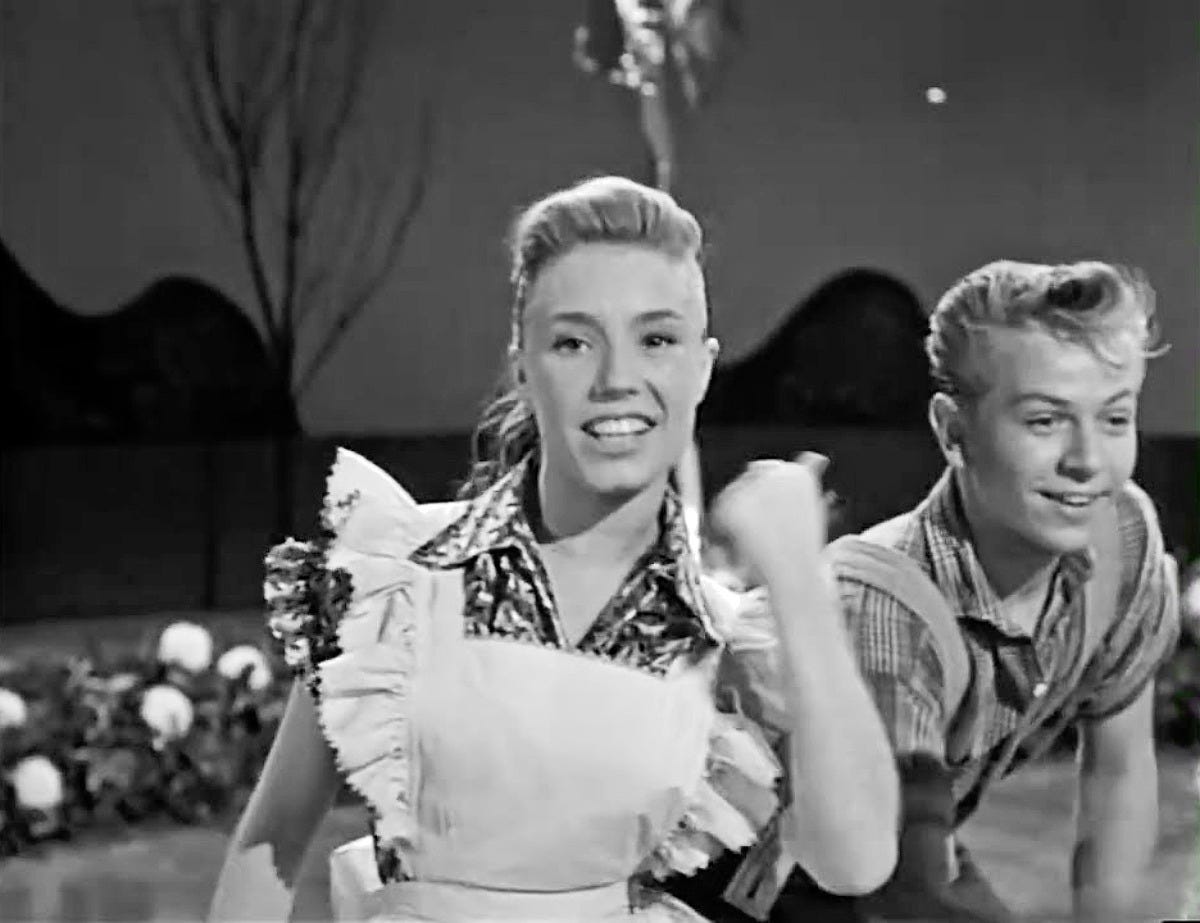
Funicello remembered the excitement.
“We were so excited. What child wouldn’t be thrilled to be ‘working’ in Oz?” she said, as Korkis reported.
What was in the 1957 Rainbow Road to Oz preview?
It aired Sept. 11, 1957, on “The Fourth Anniversary Show,” an episode of Walt’s Disneyland series, according to D23.
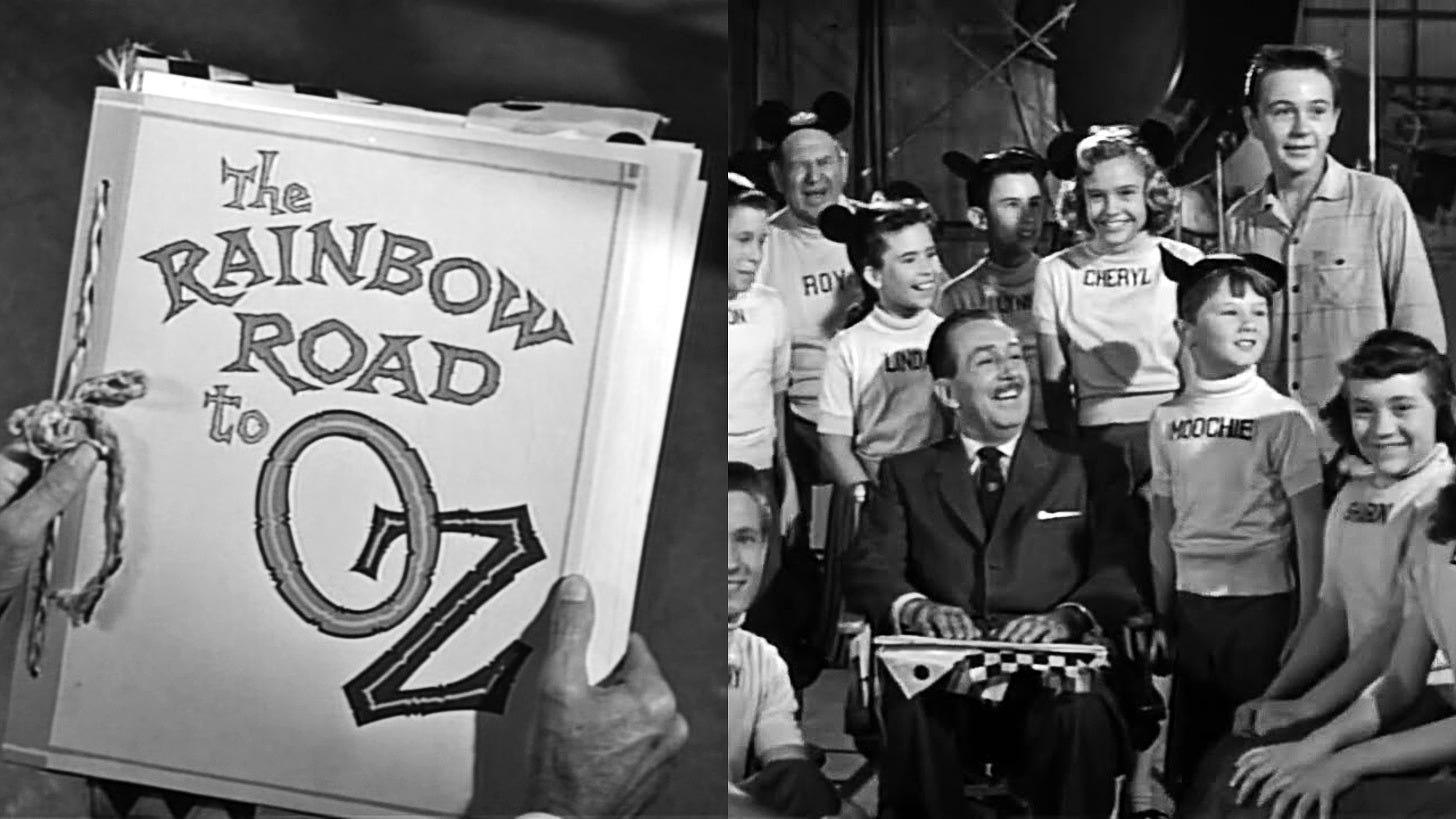
The Mouseketeers surprise Walt with two musical numbers from a movie they hope he’ll let them star in. He agrees, and they celebrate, D23 says. Those two numbers are the only parts of the movie ever filmed.
They were shot on three sets, including 120 feet of Yellow Brick Road, D23 noted.
Walt played along on camera. “Now, I am going to make a picture out of the Oz stories but I always figured to make it as a cartoon,” he said, according to Korkis.
Mouseketeer Cubby O’Brien had a comeback ready: “but it takes you seven or eight years to make a cartoon feature, doesn’t it?”
A fan uploaded the Rainbow Road segment from the episode:
What songs were written for The Rainbow Road to Oz?
Several, according to Korkis.
They included “Patches,” “The Oz-Kan Hop” and the title song, “The Rainbow Road to Oz,” with lyrics by Sid Miller and Tom Adair and music by Buddy Baker. Two more, “Why Don’t They Believe?” and “The Lost Princess Waltz,” came later in 1957.
A couple of the songs got a second life. “The Oz-phabet” and “The Pup Pup Puppet Polka” turned up on the 1969 Disneyland Records album “The Cowardly Lion of Oz,” Korkis wrote.
Why was The Rainbow Road to Oz canceled?
Disney never gave an official reason, Korkis wrote.
By February 1958, the project had died, D23 says, because Walt was frustrated with the script and the designs. He may also have feared competing with MGM’s 1939 “The Wizard of Oz,” which was picking up new fans through TV airings.
Korkis pointed to a few more likely factors:
The rest of Baum’s Oz books were set to enter the public domain starting in 1960, opening the door to cheap competitors.
“The Mickey Mouse Club” was losing steam, and it was canceled in 1959.
Costs were climbing, and Walt was busy with new Disneyland attractions and “Sleeping Beauty.”
The idea didn’t die all at once. A December 1961 report still listed it as in development for 1963, Korkis noted. It never moved forward.
Did Disney ever make an Oz movie?
Yes, but not Walt’s.
Disney released “Return to Oz” in 1985, directed by Walter Murch, with no songs and a totally different plot, according to D23. D23 says the movie finally fulfilled “that early dream of Walt Disney’s.”
Disney went back to Oz again with “Oz the Great and Powerful” in 2013.
What are some fun facts about The Rainbow Road to Oz?
Gillespie handed Walt a giant script. On the TV special, she presented him with a big book titled “The Rainbow Road to Oz,” and called it “more of a shooting script,” Korkis wrote.
A Disney legend drew the Cowardly Lion. Bill Peet, who went on to write the story for Disney’s “One Hundred and One Dalmatians,” drew the sketch shown on TV, according to Korkis.
The show had more than Oz. Walt also told the story of meeting composer Sergei Prokofiev in 1938 and showed “Peter and the Wolf,” and he introduced Guy Williams as Zorro, D23 says.
The 12th book cost a fortune. Walt paid nearly as much for it as for the first 11, according to D23.
Article compiled with the help of the Pirates & Princesses newsroom.
Pirates and Princesses is your destination for Disney news, theme park updates, and the pop culture you love. From Disney cruises and travel tips to Disney fashion, food, collectibles, and movie news, PNP covers it all. Visit us at piratesandprincesses.net for daily coverage. Follow PNP on Facebook and Instagram, and listen to the Pirates & Princesses podcast on Apple Podcasts and YouTube.
Hat Tips:
D23 Disney A to Z: The Rainbow Road to Oz, The Fourth Anniversary Show (television) and Return to Oz (film) entries
Jim Korkis, MousePlanet, Nov. 24, 2010: Walt’s Journey to Oz
Disney Ashman Demos on YouTube: The Rainbow Road to Oz segment from The Fourth Anniversary Show (1957)
AI Disclosure: All articles are assigned, edited and reviewed by an experienced human editor before posting. Like most modern newsrooms, WebReef Media uses a variety of AI tools to help with accuracy and efficiency. Ways AI may be used in article creation include research, grammar, fact-checking and ideation, as well as occasional AI generated or enhanced thumbnails or graphics. No articles are generated or posted without human oversight or involvement.