

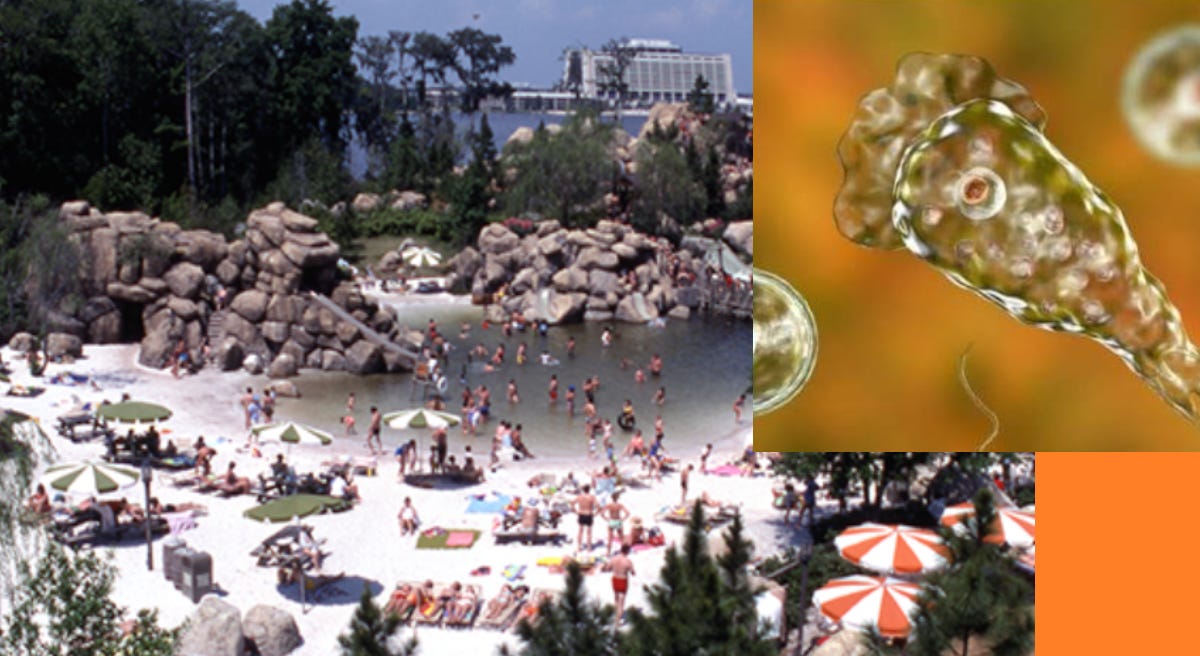
Disney’s River Country opened June 20, 1976, where guests swam in filtered lake water. It has sat abandoned for nearly 20 years after it closed in 2001. Was it closed down over a brain-eating amoeba?
Ask a Disney fan why River Country closed and you’ll get one of two answers. A kid died from a brain-eating amoeba, or Florida passed a law banning swimming in lake water.
The first thing happened in 1980. The park ran for 21 more years after that incident. The second thing never happened at all.
Disney World’s first water park opened on June 20, 1976, closed for the season in the fall of 2001, and never reopened. What actually killed it is much less dramatic.
What was River Country at Disney World?
A six-acre “ol’ swimmin’ hole” tucked into the Fort Wilderness campground, built to look like a Tom Sawyer hideout. The centerpiece was Bay Cove, a half-acre sand-bottom lagoon fed by Bay Lake itself. Lake water was pumped through filters and into the cove, so you were swimming in the lake, technically, but the lake had been cleaned up first.
Around it: Whoop ‘N Holler Hollow, a pair of 260-foot slides pushing 2,000 gallons a minute; White Water Rapids, an inner-tube run; Slippery Slide Falls; and a conventional pool, Upstream Plunge, holding about 330,000 gallons.
It was a hit. D23 credits its success with getting Typhoon Lagoon and Blizzard Beach built.
Did someone die from an amoeba at River Country?
Yes. In August 1980, an 11-year-old boy from New York died of amoebic meningoencephalitis after swimming at the park, per Associated Press coverage at the time citing the Orange County Health Department. The organism generally blamed is Naegleria fowleri, which lives in warm freshwater everywhere in Florida.
It was a real tragedy and a real risk of swimming in a Florida lake in August.
This also happened 21 years before the park closed.
Disney said at the time that it ran “a thorough program of water-quality control in cooperation with health officials,” and the park kept operating through the 1980s and 1990s without another case.
If the amoeba had closed River Country, it would have closed it in 1980.
Did a Florida law shut down River Country?
No. This one gets repeated constantly, and it’s simply not true. The version you’ll hear is that Florida passed a law around 2001 requiring water parks to use municipal water, which made a lake-fed park illegal.
Yesterland, the extinct-attractions site, went and read the state rules. Florida requires water in a public bathing place to meet drinking-water standards. As the site puts it, “There is no requirement that it must come from a municipal water system.“ Filtered lake water that passes the test is fine.
River Country’s water passed the test for 25 years.
So why did River Country really close?
Money and timing. By 2001, Disney had two bigger, newer water parks a short drive away. River Country was small, old, and, per AllEars, “the park simply couldn’t sustain demand next to its much larger siblings.“
Then came Sept. 11, 2001. Tourism to Orlando cratered that fall.
The park closed for its normal off-season, and Disney quietly didn’t reopen it in 2002. A spokesman told the Orlando Sentinel in April 2002 that it could come back with “enough guest demand.”
The demand didn’t come. On Jan. 20, 2005, Disney confirmed River Country was closed for good.
What happened to the abandoned River Country?
Nothing, for a long time. Disney left it standing. The slides, the cove, the buildings all sat there, visible from the boat to Fort Wilderness, slowly turning green.
Urban explorers snuck in and posted photos through the 2010s. It became one of the most famous abandoned places in Florida.
Disney filled in the Upstream Plunge pool in 2016. Demolition of the rest started in March 2019, and the site was cleared within about a month.
What’s on the River Country site now?
A hotel, finally. Disney announced Reflections, A Disney Lakeside Lodge for the spot in October 2018, then paused it in 2020 and scrubbed it from its websites. In November 2024 the project came back under a new name, Disney Lakeshore Lodge, a 967-room Disney Vacation Club resort.
It’s under construction now and scheduled to open July 1, 2027. Disney’s own announcement describes it as sitting “nestled along the tranquil shores of Bay Lake,” which is a nicer way of saying it’s on top of the old swimmin’ hole.
A few more River Country facts
The last operating day is a fan argument in itself. D23 says Sept. 1, 2001. AllEars and others say Nov. 2, 2001.
Everyone agrees it was a seasonal close that turned permanent.
The Cabins at Fort Wilderness, the DVC project that opened in July 2024, is next door but not on the River Country land. Lakeshore Lodge is.
Twenty-five years after the last swim, the lake is still there, still warm, and still not the reason the park closed.
Article compiled with the help of the Pirates & Princesses newsroom.
Pirates and Princesses is your destination for Disney news, theme park updates, and the pop culture you love. From Disney cruises and travel tips to Disney fashion, food, collectibles, and movie news, PNP covers it all. Visit us at piratesandprincesses.net for daily coverage. Follow PNP on Facebook and Instagram, and listen to the Pirates & Princesses podcast on Apple Podcasts and YouTube.
Hat Tips:
D23 (River Country A-to-Z entry), opening date, the Bay Lake concept, the 330,000-gallon figure and the Typhoon Lagoon link
Yesterland (River Country parts 1 and 2), the six-acre size, the Bay Cove filtration, the 1980 AP coverage and Disney statement, and the Florida water-standards rule
AllEars (Jan. 2020), the closure reasons, the 2016 pool fill and the 2005 confirmation
Park Lore, the April 2002 Orlando Sentinel spokesman quote and the urban-explorer era
WDWNT (March 2019), the demolition
Disney Parks Blog (Aug. 2026), the Lakeshore Lodge construction update and quote
DVC News (July 2024), the Fort Wilderness cabins opening
AI Disclosure: All articles are assigned, edited and reviewed by an experienced human editor before posting. Like most modern newsrooms, WebReef Media uses a variety of AI tools to help with accuracy and efficiency. Ways AI may be used in article creation include research, grammar, fact-checking and ideation, as well as occasional AI generated or enhanced thumbnails or graphics. No articles are generated or posted without human oversight or involvement.