

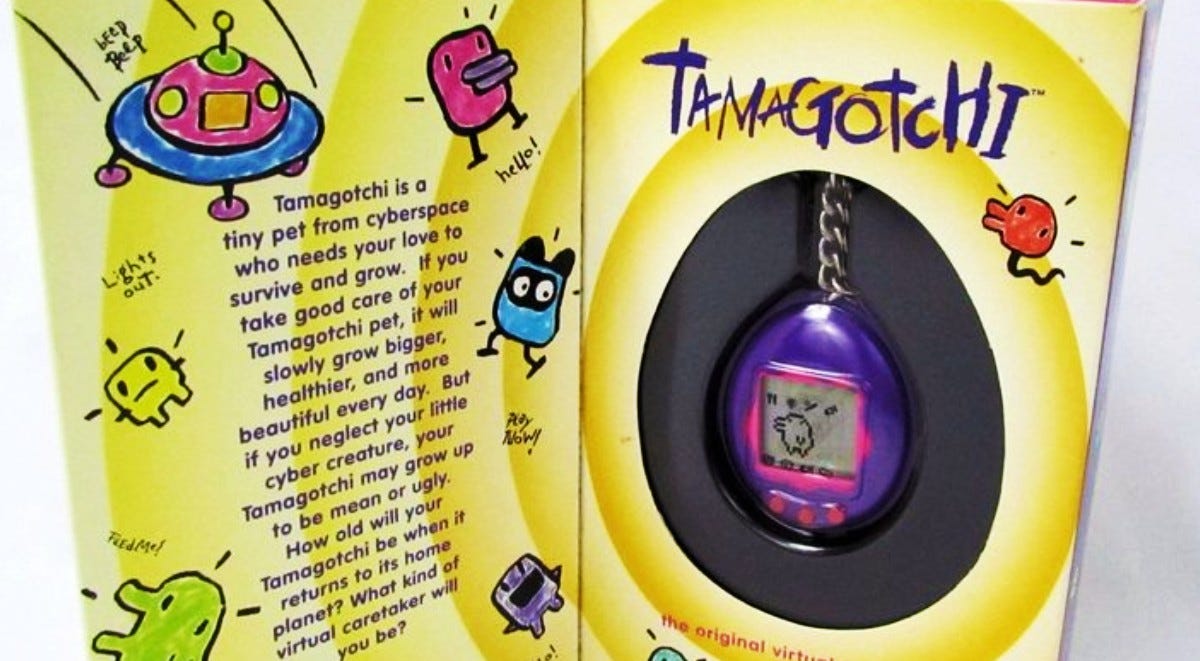
Bandai’s virtual pet went on sale in Japan on Nov. 23, 1996, hit America the next May, and has now shipped more than 100 million units. Schools banned it, a cemetery buried it, and it’s still selling.
Tamagotchi turns 30 on Nov. 23, 2026. That’s the day in 1996 that Bandai put a plastic egg with a tiny screen on sale in Japan and, without meaning to, started a global panic about dead pixels.
Thirty years later, Bandai’s official count stands at “over 100,000,000 units have been shipped worldwide since 1996.“ The company is throwing itself a birthday party across two continents, and the toy that beeped through your third-grade math test is still on shelves at Target.
Who invented the Tamagotchi?
Two people, and one of them was a woman in Bandai’s marketing department. Aki Maita worked in sales and planning at Bandai. Akihiro Yokoi ran a small toy company called WiZ. Together they built a pet that needed to be fed, cleaned up after and put to bed, and that died if you forgot.
The name mashes together the Japanese word for egg, tamago, and the English word watch. Egg watch. It was a keychain, so it fit.
Bandai’s numbers say Japan bought 10 million of them in the first eight months. By spring 1998 the worldwide figure was around 40 million.
When did Tamagotchi come to the United States?
May 1997, per Smithsonian Magazine, at $17.99. The U.S. launch is where the toy became a problem for grown-ups.
The pet died in real time, whether you were in class or not. Kids brought them to school and checked them under the desk.
Within weeks, schools were banning them. The Honolulu Star-Bulletin reported on June 2, 1997, that three Oahu schools, including Punahou and Iolani, had banned the eggs, and that Iolani charged a $1 ransom to get a confiscated one back.
Mental Floss tracked a New York elementary school where third-graders got caught feeding their pets during a standardized test. Bans spread to Hong Kong, Thailand, and mainland China.
Did Tamagotchi really win a Nobel Prize?
An Ig Nobel, which is the joke version handed out at Harvard every fall. In 1997, the Ig Nobel in Economics went to Yokoi and Maita “for diverting millions of person-hours of work into the husbandry of virtual pets.“
Nobody at Bandai objected. It was accurate.
Was there really a Tamagotchi cemetery?
Yes, and it wasn’t in Japan. A pet cemetery in Pontsmill, Cornwall, in southwest England, run by a man named Terry Squires, started accepting dead Tamagotchis in the late 1990s. Owners mailed them in from Switzerland, Germany, France, Canada, and the U.S., with little headstones and notes.
It made CNN in January 1998. The internet still argues about whether it was sweet or deeply strange. It was both.
Is Tamagotchi still around in 2026?
Very much. Bandai relaunched the line for the modern era with Tamagotchi Uni in July 2023 at $59.99, the first model with Wi-Fi, and followed with Tamagotchi Paradise in August 2025 at $44.99, which lets you zoom in on your pet’s organs. That’s a sentence that means something to an eight-year-old.
The 100-million milestone was crossed as of July 31, 2025, per Bandai Namco’s investor newsletter. About half of those shipped in Japan, a third in the U.S. and the rest mostly in Europe.
Taro Tsuji, whose actual title is Chief Tamagotchi Officer, told investors “the value of content lies not in its specs but in the relationships it generates.“ Which is a very corporate way of saying people cry when the thing dies.
What is Bandai doing for the Tamagotchi 30th anniversary?
A lot. Bandai’s Feb. 14, 2026 announcement listed a 30th Anniversary Tamagotchi device, a retro “Original Tamagotchi” line called Y3K, partnerships with CASETiFY, Kura Sushi and Sunstar, and a Times Square pop-up with MINISO.
The Tamagotchi USA Road Trip, a traveling fan event, ran Aug. 15 through Oct. 4, 2026, hitting eight cities from Minneapolis to Memphis. Last year’s tour drew more than 15,000 people.
In Japan, the main celebration lands in November 2026 with a Tamagotchi store in Harajuku and a big exhibition running into 2027. There’s also a Tamagotchi Ring, an actual ring you wear, at 7,700 yen, shipping in early 2027. Preorders close Oct. 6, 2026.
Does Disney have a Tamagotchi?
It does. Bandai released a Toy Story Tamagotchi in 2022 with Woody, Buzz and the gang as your pets, and it has run a string of Hello Kitty and Sanrio versions since 2020, including a Sanrio Uni in 2024. If you’ve been holding out, that’s your excuse.
Thirty years in, it still needs feeding. Some things never change, and some things just beep until you deal with them.
Article compiled with the help of the Pirates & Princesses newsroom.
Pirates and Princesses is your destination for Disney news, theme park updates, and the pop culture you love. From Disney cruises and travel tips to Disney fashion, food, collectibles, and movie news, PNP covers it all. Visit us at piratesandprincesses.net for daily coverage. Follow PNP on Facebook and Instagram, and listen to the Pirates & Princesses podcast on Apple Podcasts and YouTube.
Hat Tips:
Bandai (official Tamagotchi history page), the Nov. 23, 1996 launch and the 100 million shipped figure
Bandai Namco (Investor Relations Newsletter 82), first-year Japan sales, regional split, the Taro Tsuji quote and the 2026-2027 anniversary plans
Bandai / PR Newswire (Feb. 14 and July 2026 releases), the 30th anniversary product lineup, partnerships and the 2026 Road Trip dates
Smithsonian Magazine, the May 1997 U.S. launch and creator background
Honolulu Star-Bulletin (June 2, 1997), the Oahu school bans and the $1 ransom
Mental Floss, the New York school incident and creator credits
Improbable Research, the 1997 Ig Nobel citation
Vice and Burials & Beyond, the Pontsmill, Cornwall cemetery
Toy Tales and PR Newswire, Uni and Paradise release dates and prices
SoraNews24 (Sept. 1, 2026), the Tamagotchi Ring
Bandai America and Siliconera, the Hello Kitty and Toy Story collaborations
AI Disclosure: All articles are assigned, edited and reviewed by an experienced human editor before posting. Like most modern newsrooms, WebReef Media uses a variety of AI tools to help with accuracy and efficiency. Ways AI may be used in article creation include research, grammar, fact-checking and ideation, as well as occasional AI generated or enhanced thumbnails or graphics. No articles are generated or posted without human oversight or involvement.