

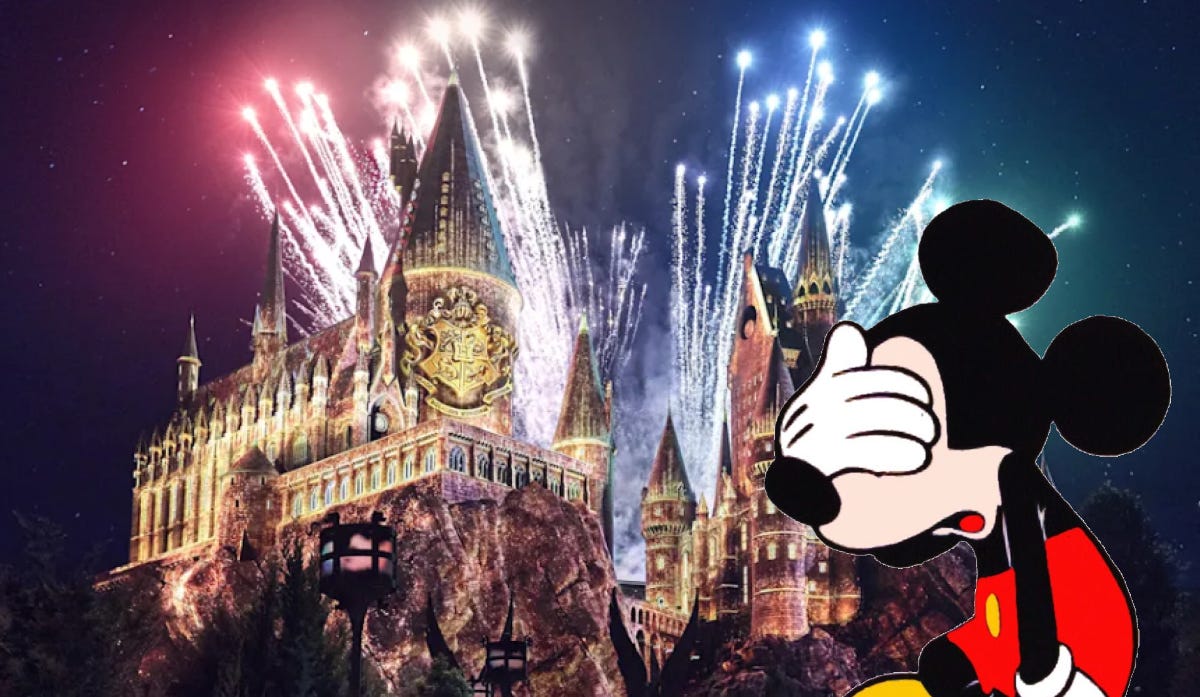
Disney had the chance to build a Harry Potter land, and let it slip away to Universal. That decision reshaped the entire theme park industry. With a new Harry Potter series arriving this Christmas, here’s the story of the deal that got away, and why it still haunts Disney.
It’s one of the biggest “what ifs” in theme park history: Disney once had the chance to bring Harry Potter to its parks, and let it walk right out the door to Universal.
That single decision reshaped the entire theme park world. And with a brand-new Harry Potter series about to premiere, it’s a perfect time to look back at how Disney missed out on the boy wizard, and why the sting hasn’t faded. Here’s the whole story.
Disney had the wizarding world first
Let’s start at the beginning, because Disney genuinely had the inside track.
Back in the mid-2000s, around 2004, author J.K. Rowling was riding the astronomical success of the Harry Potter books and films, and both Disney and Universal wanted a piece of it. Disney entered negotiations to bring a Harry Potter presence to Walt Disney World, and by most accounts, Rowling even signed a letter of intent. The opportunity was Disney’s to lose.
And lose it, they did.
Why the deal fell apart
Here’s the heart of the story, and it’s more about philosophy than money.
The breakdown came down to two big clashes:
Disney’s plan was too small. Rather than a sprawling, immersive land, Disney reportedly wanted to add just a couple of Harry Potter rides tucked into an existing area like Fantasyland. To Rowling, that felt like an afterthought, not a proper wizarding world.
Rowling demanded total creative control. Backed by Warner Bros., she insisted on strict authenticity: no Disney characters wandering around Hogsmeade, no generic Disney-branded merchandise in the shops, and complete say over how everything looked and felt. She wanted guests to feel like they’d stepped into the real wizarding world, with zero reminders they were in a theme park.
That second point was the dealbreaker. Disney is a company built on controlling its intellectual property, putting Mickey ears on everything and cross-promoting its brands. The idea of handing an outside author that much authority, and giving up its own branding, went against Disney’s entire way of doing business. Neither side would budge, and Disney terminated the negotiations.
Universal said yes to everything
Here’s the pivot that changed theme park history.
Once Disney walked, Universal, eager to finally compete with the Mouse, swooped in. And crucially, Universal agreed to all of Rowling’s demands. Total creative control? Yes. Full authenticity with no outside branding? Yes. A massive, immersive land instead of a couple of rides? Absolutely, Universal even scrapped its more modest original plans to go bigger.
The deal was announced in 2007, and The Wizarding World of Harry Potter opened at Universal’s Islands of Adventure in 2010. It was an instant phenomenon.
It changed everything
Here’s just how big a deal this turned out to be.
The Wizarding World wasn’t just a hit, it was a genuine game-changer that rewrote the rules of the industry:
Universal finally became a must-visit destination. For the first time, Universal had a product that could go toe-to-toe with Disney. Attendance reportedly jumped around 10% in the first year alone.
It kicked off the “immersive single-IP land” era. The success proved fans would flock to deeply-themed, single-property lands, directly inspiring what came next.
It arguably forced Disney’s hand. Many believe the Wizarding World’s success is a big reason Disney went on to build Pandora: The World of Avatar and Star Wars: Galaxy’s Edge, massive, immersive single-IP lands of its own.
Universal expanded the magic in 2014 with Diagon Alley and the Hogwarts Express connecting two parks, replicated it in Hollywood and Japan, and made it the anchor of its brand-new Epic Universe park. Harry Potter didn’t just help Universal, it transformed it.
Was Disney wrong to walk away?
Here’s the fair question, because it’s not as simple as “Disney blew it.”
In hindsight, passing on Harry Potter looks like a colossal blunder. But Disney’s reasoning wasn’t crazy at the time. The company’s whole model is built on total control of its properties, and that philosophy has served it spectacularly well. It’s the same instinct that lets Disney do incredible things with Star Wars and Marvel, brands it fully owns and controls. Ceding that control to an outside author, on Rowling and Warner Bros.’ terms, genuinely conflicted with how Disney operates.
So it wasn’t a dumb decision, it was a values clash. Disney bet on control; Universal bet on collaboration. It just so happens that, this one time, Universal’s bet paid off in the biggest way imaginable.
Why it still stings: Harry Potter is evergreen
Here’s the part that keeps the wound fresh, and it’s the real kicker.
If Harry Potter had faded into nostalgia, Disney’s miss wouldn’t matter much. But the franchise refuses to slow down. Hogwarts Legacy was the best-selling video game of 2023, moving over 22 million copies. The books have sold more than 600 million copies worldwide. And the biggest proof of all is arriving this Christmas.
HBO‘s massive new Harry Potter reboot series premieres December 25, 2026, a faithful, decade-long adaptation planned to cover all seven books, one season at a time, with a starry cast including John Lithgow as Dumbledore. It’s a ten-year commitment to a property everyone knows will still be printing money a decade from now.
That’s what makes Disney’s miss sting. This isn’t a fad that came and went, it’s a genuinely evergreen, generation-spanning franchise that’s still growing 25 years on. Disney had it in their hands, and let it go.
How Disney lost Harry Potter: the what-if that still haunts the parks
Disney lost Harry Potter to Universal not over money, but over control, unwilling to give J.K. Rowling and Warner Bros. the creative authority (and hands-off branding) they demanded. Universal said yes, built the Wizarding World, and turned itself into a genuine Disney rival in the process, arguably the single most consequential theme park decision of the century.
Was it a defensible choice at the time? Sure. Does it still sting? Absolutely, especially as Harry Potter keeps proving it’s one of the most durable franchises on Earth, with a huge new series about to hit this very Christmas.
Disney has done just fine, of course; Pandora and Galaxy’s Edge are doing fine. But somewhere in an alternate universe, there’s a Wizarding World inside Walt Disney World, and every time you sip a Butterbeer at Universal, you’re tasting the deal that got away.
Disney had the golden snitch in hand. They just didn’t close their fist.
Article compiled with the help of the Pirates & Princesses newsroom.
Pirates and Princesses is your destination for Disney news, theme park updates, and the pop culture you love. From Disney cruises and travel tips to Disney fashion, food, collectibles, and movie news, PNP covers it all. Visit us at piratesandprincesses.net for daily coverage. Follow PNP on Facebook and Instagram, and listen to the Pirates & Princesses podcast on Apple Podcasts and YouTube.
Hat Tips:
AllEars.Net and Theme Park Insider (2012-2020), verified for the Disney-Rowling negotiation details (the mid-2000s talks, the letter of intent, Disney’s smaller Fantasyland-rides plan, Rowling’s creative-control and authenticity demands including no outside branding, the objection to Disney characters and Coca-Cola/merchandise, the breakdown and Disney’s termination of talks)
Looper and Screen Rant (2020-2023), verified for Universal agreeing to Rowling’s terms, the 2007 deal announcement, the 2010 Wizarding World opening at Islands of Adventure, the ~10% first-year Universal attendance jump, the 2014 Diagon Alley/Hogwarts Express expansion, and the argument that it spurred Disney’s Pandora and Galaxy’s Edge
Rotten Tomatoes, Deadline, and Wikipedia (2026), verified for the HBO Harry Potter series (December 25, 2026 premiere, the decade-long one-season-per-book plan, showrunner Francesca Gardiner, the cast including John Lithgow as Dumbledore), plus Hogwarts Legacy’s 2023 best-selling status (22M+ units) and the 600M+ books sold as evidence of the franchise’s evergreen demand