

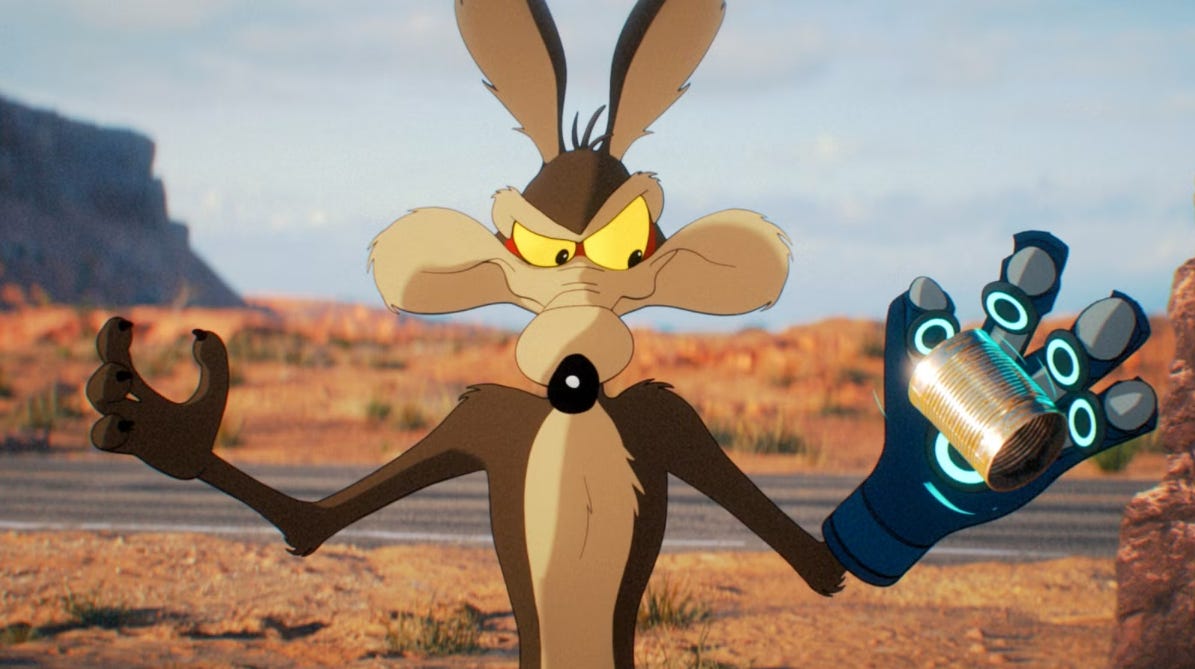
Coyote vs. Acme was shelved for a tax write-off, sold for about $50 million, and has now outgrossed its own budget. Warner Bros. does not see a dollar of it.
Warner Bros. decided “Coyote vs. Acme” was worth more as a tax write-off than as a movie.
The finished film is now approaching $100 million worldwide.
Confirmed figures put it at $82.8 million globally after its third weekend, with $47.8 million domestic and $35 million international. It added an estimated $4.5 million in its fourth weekend, pushing past $54 million domestically.
Its production budget was $70 million.
Why did Warner Bros. shelve Coyote vs. Acme?
For the tax benefit.
The studio finished the film and then decided not to release it, taking a write-down instead. The practice became common at Warner Bros. Discovery during a stretch when completed projects were shelved for accounting reasons, and “Coyote vs. Acme” became the most visible example.
The difference with this one was the reaction. Filmmakers, animators, and fans pushed back publicly and loudly, and the campaign went on long enough that the studio eventually allowed the film to be shopped.
Who bought Coyote vs. Acme?
Ketchup Entertainment, which acquired the completed film for roughly $50 million.
That is the same distributor behind “The Day the Earth Blew Up,” another Looney Tunes feature that found an audience after a larger studio passed.
A smaller company paid $50 million for something a major studio valued at zero. The film has since grossed more than that, which does not make Ketchup whole on its own, since distribution and marketing come out of those numbers too, but it puts the deal well into defensible territory.
Is Coyote vs. Acme a hit?
By the standards that apply to it, yes.
It has passed its production budget worldwide and stayed in the global top five for multiple weekends. Its third weekend brought $13.5 million worldwide, and it dropped 48 percent domestically in that frame, which is a normal hold rather than a collapse.
Warner Bros. Discovery receives none of it.
What is Coyote vs. Acme about?
Wile E. Coyote sues the Acme Corporation over its defective products.
The premise comes from a 1990 New Yorker piece by Ian Frazier written as a legal complaint, which is one of the more unlikely sources for a studio feature. Director Dave Green made it as a live-action and animation hybrid.
What does this mean for shelved films?
More than one studio is watching.
The write-off strategy depended on a fairly simple assumption, which is that an unreleased film has no realizable value. A shelved movie grossing nine figures after being sold for a fraction of its cost is a direct argument against that.
It does not automatically change anyone’s tax accounting. It does change the public conversation the next time a studio shelves something finished, and it gives the people making those films a case to point at.
Warner Bros. Discovery is currently in the middle of settlement talks over its proposed merger with Paramount Skydance, where one of the terms reportedly under discussion is a commitment to release a minimum number of films theatrically each year.
Given the last few years, that is a term with some history behind it.
Article compiled with the help of the Pirates & Princesses newsroom.
Pirates and Princesses is your destination for Disney news, theme park updates, and the pop culture you love. From Disney cruises and travel tips to Disney fashion, food, collectibles, and movie news, PNP covers it all. Visit us at piratesandprincesses.net for daily coverage. Follow PNP on Facebook and Instagram, and listen to the Pirates & Princesses podcast on Apple Podcasts and YouTube.
Hat Tips:
Cartoon Brew (Sept. 14, 2026), the confirmed worldwide, domestic and international totals, the budget, the Ketchup acquisition price and the third-weekend figures
Fortune (Aug. 30, 2026), the Warner Bros. write-off background and the film’s path to release
AI Disclosure: All articles are assigned, edited and reviewed by an experienced human editor before posting. Like most modern newsrooms, WebReef Media uses a variety of AI tools to help with accuracy and efficiency. Ways AI may be used in article creation include research, grammar, fact-checking and ideation, as well as occasional AI generated or enhanced thumbnails or graphics. No articles are generated or posted without human oversight or involvement.