

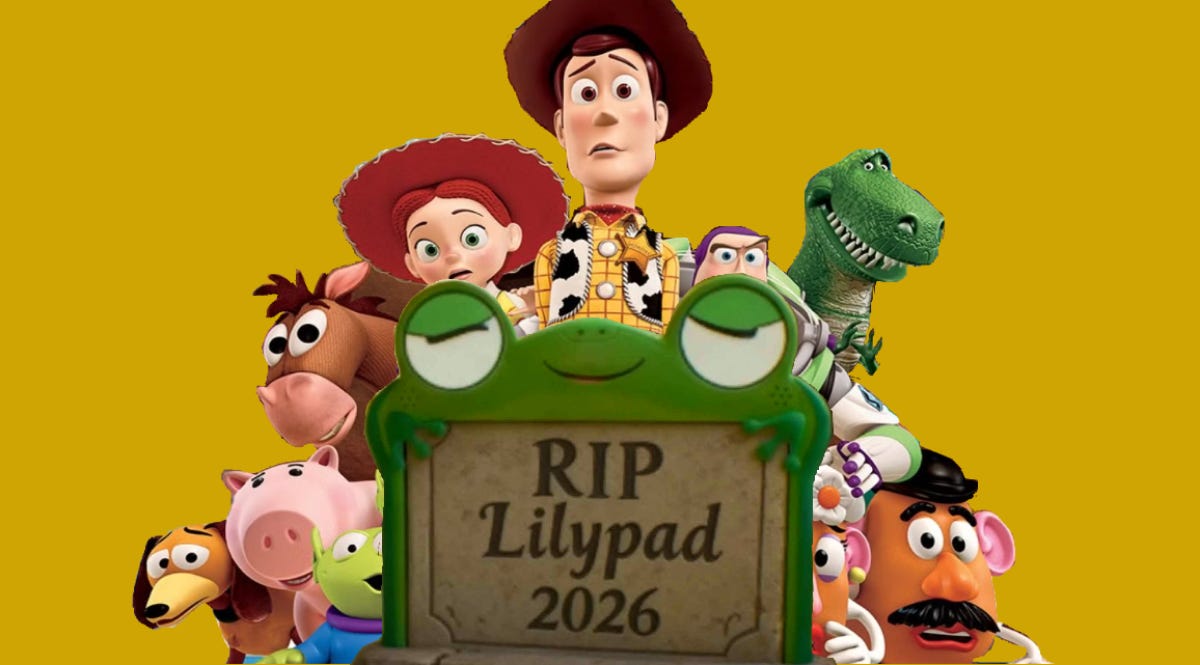
Spoilers ahead. The filmmakers reveal that an early version of the movie considered killing off the frog-shaped tablet villain. Here’s why they decided against the easy “toys good, tech bad” ending, and what they did instead.
Toy Story 5 almost ended with the death of its villain. The filmmakers behind the movie just revealed that an early version of the story considered killing off Lilypad, the frog-shaped tablet that drives the whole film.
They didn’t do it, and the reason why is actually the most interesting thing about how the movie came together. Quick heads-up: there are spoilers ahead.
Who Lilypad is
If you haven’t seen it yet, here’s the setup.
Lilypad, or “Lily,” is a frog-shaped smart tablet voiced by Greta Lee. She’s the new “villain” of Toy Story 5, representing the thing every modern parent worries about: screens replacing playtime. When Bonnie gets the tablet, she stops playing with Woody, Jessie, and the gang and gets pulled into the digital world, which is exactly the existential threat the toys have to face.
She’s a clever stand-in for the “iPad kid” era, a tablet that’s slowly stealing a child’s attention away from her toys.
The ending they considered
Here’s the behind-the-scenes reveal.
At the very first internal screening of the movie, opinions in the room were split. Co-director McKenna Harris recalls some strong early reactions, including people saying, in her words, “Wouldn’t it be great if Lilypad just died at the end?”
It’s an understandable instinct. Lilypad is the thing keeping Bonnie from her toys, so having the toys defeat her for good would’ve felt like a clean, satisfying win. Villain shows up, villain gets beaten, everybody cheers. That’s how a lot of movies would handle it.
Why they didn’t do it
But the filmmakers decided that easy ending was the wrong one, and their reasoning is sharp.
Killing off Lilypad, they realized, would’ve turned the movie into the obvious, simpler version of itself: toys good, technology bad, problem solved. A tidy little fable about how screens are evil and should be destroyed.
The team didn’t think that was true to real life. As director Andrew Stanton put it, “We’re not getting rid of these devices, no matter how hard we try.” Tablets and screens aren’t going away, and pretending the answer is to just smash them would’ve been a cop-out. Stanton even resisted calling Lilypad a straight villain, noting “Lily means well, like all good villains.” The tablet isn’t evil, it’s a tool that gets out of balance.
What they did instead
So they went with a harder, more honest ending.
Instead of being destroyed, Lilypad survives, but gets put in her proper place: a useful tool for specific things, not the master of Bonnie’s whole life. The movie lands on coexistence rather than destruction, the idea that screens and imagination can both exist, as long as the screen isn’t running the show.
It’s a more grown-up message than “technology bad,” and it’s a lot more useful for the actual kids and parents watching. The film isn’t telling you to throw the iPad in the trash. It’s saying: keep it in its lane, and don’t let it crowd out everything else.
Why this is the better call
Here’s why the filmmakers’ choice matters.
A villain death would’ve gotten a cheer in the moment, but it would’ve made Toy Story 5 a weaker, preachier movie. By letting Lilypad live and finding balance instead, Pixar made something that actually reflects how families really deal with technology, not by banning it, but by managing it.
It fits the franchise, too. Toy Story has always been about toys facing change and learning to adapt, Andy growing up, getting handed off to Bonnie, and now Bonnie growing into a screen age. Adapting to the new world has always been the point, not pretending the old world can stay frozen.
So Toy Story 5 could’ve gone for the easy, crowd-pleasing kill. Instead, it chose the ending that treats both kids and screens like they’re part of real life, complicated, here to stay, and best handled with balance instead of a battle. Sometimes the bravest creative choice is letting the villain live. Pixar made the right call.
Pirates and Princesses is your destination for Disney news, theme park updates, and the pop culture you love. From Disney cruises and travel tips to Disney fashion, food, collectibles, and movie news, PNP covers it all. Visit us at piratesandprincesses.net for daily coverage. Follow PNP on Facebook and Instagram, and listen to the Pirates & Princesses podcast on Apple Podcasts and YouTube.
Hat Tips:
Gold Derby (June 2026), the filmmaker interview, verified for co-director McKenna Harris’s “wouldn’t it be great if Lilypad just died at the end” quote, the divided first-screening reaction, the coexistence-over-destruction decision, and Andrew Stanton’s first-draft details
Variety (May 26, 2026), verified for the “we’re not getting rid of these devices” quote, Lilypad as the device antagonist, Greta Lee voicing the character, and the not-a-traditional-villain framing
Empire and FirstCuriosity (April–June 2026), verified for Stanton’s “when tech comes in, it wins” and “Lily means well, like all good villains” quotes, and the screen-time-versus-playtime themes