

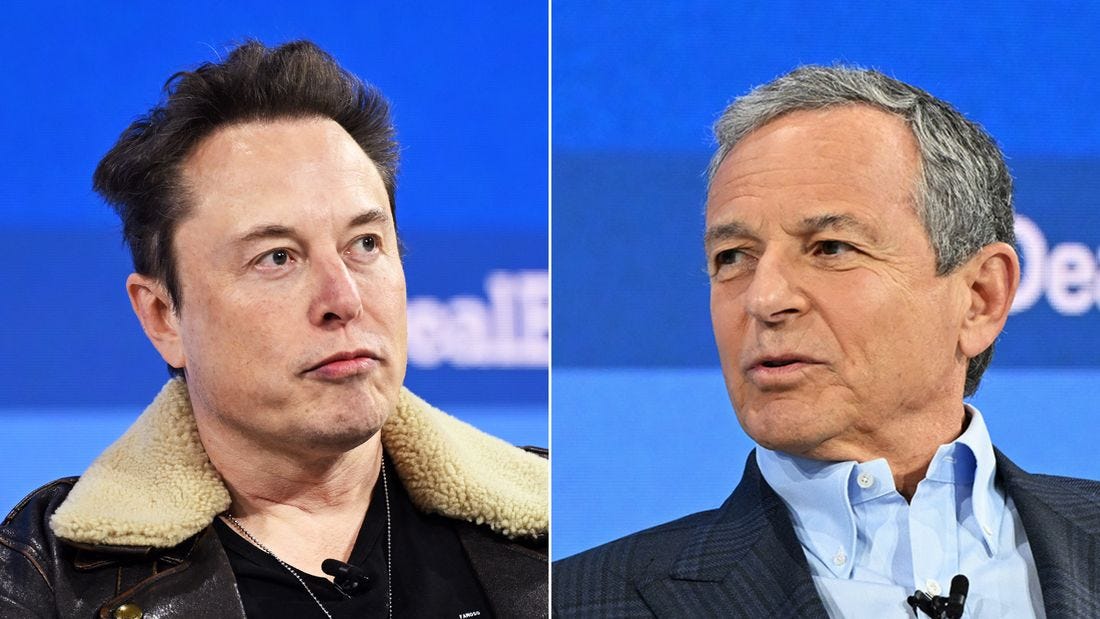
Bob Iger has been telling the “we nearly bought Twitter and I got cold feet” story since 2019. It just hits different now that the platform he walked away from became X, and its owner told him to go f--- himself on a stage in front of everyone.
A story about Disney nearly buying Twitter is trending again, framed as a fresh Bob Iger revelation. It isn’t fresh. Iger’s been telling this one for years. What’s changed is everything around it, which is exactly why it keeps coming back.
The short version, for anyone who missed the previous three times it made news: back in 2016, Disney came close to buying Twitter, and Iger walked away at the last minute because the platform was too nasty for the Mouse House.
Every word of that has been public since his 2019 memoir. The reason it’s worth retelling in 2026 is the punchline the story didn’t have yet.
What Iger actually said, and when
Let’s clear up the “reveals” part, because the timeline matters.
Iger first laid this out in his 2019 memoir The Ride of a Lifetime. Disney saw Twitter as a ready-made global distribution platform, a way to get its content to consumers worldwide without spending years building the technology itself. The board gave him the green light to close the deal. Then, as he tells it, he got cold feet over what Disney would be taking on: the hate speech, the fake accounts, and “the general rage and lack of civility that was sometimes evident on the platform.”
He called Twitter CEO Jack Dorsey, who was on Disney’s own board at the time, to kill it. Dorsey was “stunned, but very polite.” Iger hung up “feeling very relieved.”
He repeated the story on CNBC’s Mad Money that same year (”I got cold feet for the right reasons”), and elaborated at the 2022 Code Conference, where he added that Disney’s team had estimated a substantial chunk of Twitter accounts weren’t real people, and discounted the price accordingly. So this latest “Iger reveals” framing is really a years-old story getting another lap, likely off a new profile.
Why it lands harder now
Here’s the part that turns an old business anecdote into something with a sting.
In 2019, Iger’s worry about Twitter’s “nastiness” was an abstraction. A prudent executive dodging a messy asset. Then Elon Musk bought Twitter in 2022, renamed it X, and the platform became a vastly more turbulent place than the one Iger had walked away from. Disney, along with a long list of major advertisers, pulled its ads from X in late 2023 after Musk amplified an antisemitic post.
And then came the moment that makes this whole story sing in hindsight. At the New York Times DealBook Summit in November 2023, Musk addressed the advertisers who’d left, and told them, on stage, to “go f--- yourself.” Then he added, pointedly, “Hey, Bob,” a direct shot at Iger, who had spoken at the same event earlier that day and said Disney’s association with Musk and X was “not necessarily a positive one for us.”
So line it up. Iger nearly bought this platform, backed out specifically because he feared its toxicity, and roughly seven years later the owner of that very platform publicly cursed him out from a conference stage. The cold feet he’s been slightly sheepish about for years look, in 2026, like one of the best calls he never made.
The alternate universe is genuinely strange to imagine
Part of why this story has legs is the what-if.
Picture a Disney-owned Twitter. The company whose entire brand is “manufacturing fun,” as Iger once put it, running one of the internet’s rowdiest platforms, responsible for moderating its hate speech, its bots, and its endless fights.
Disney is famously protective of its image, the kind of company that polishes every corner of its parks and films. Bolting a social-media free-for-all onto that brand was always an awkward fit, which is precisely what Iger concluded at the eleventh hour.
Instead, Disney built its own distribution answer, Disney+, launched in 2019 and now one of the biggest streaming services in the world. Twitter went the other direction entirely. Two roads from the same 2016 fork, and Disney is plainly relieved about the one it took.
That’s why this keeps resurfacing, and why it’ll probably surface again. It’s a rare case of a giant company’s near-miss looking smarter with every passing year.
Article compiled and edited by Derek Gibbs (theme park editor) and the Pirates and Princesses newsroom.
Hat Tips:
Variety and CNBC (2019), verified for Iger’s memoir account of the 2016 Twitter talks, the distribution rationale, the board approval, the cold feet over hate speech and fake accounts, and the Jack Dorsey phone call
LAmag, via Vox Code Conference (2022), verified for Iger’s elaboration on the fake-account estimate and the price discount
Rolling Stone and The Daily Beast (November 2023), verified for Musk’s “go f--- yourself” remark at the DealBook Summit and the direct “Hey, Bob” aimed at Iger
Snopes (December 2023), verified for the timeline that Iger’s “not a positive” comment came earlier in the day, before Musk’s outburst, and the advertiser exodus over the antisemitic post